The Workflow Is the Spec
Short answer: What is workflow-based test automation?
Workflow-based test automation creates automated tests from real user journeys instead of handwritten locator scripts. A tester demonstrates the flow in the browser, the agent captures the interaction, extracts intent, and converts it into a reusable test with readable steps, resilient execution, and evidence like logs, screenshots, and recordings.
A checkout flow breaks at 2:00 AM.
Nothing important changed, someone says. The button moved. The XPath changed. The regression suite is red.
The strange part is not that the test failed. The strange part is why it failed.
The test knew yesterday’s DOM better than it knew the user’s workflow.
That is the problem with script-first UI automation. A tester already understands the business path. Then the team turns that path into tickets, steps, selectors, waits, assertions, page objects, and maintenance work.
Somewhere in that translation, the workflow stops being the source of truth.
It should be.
The Workflow Is the Spec
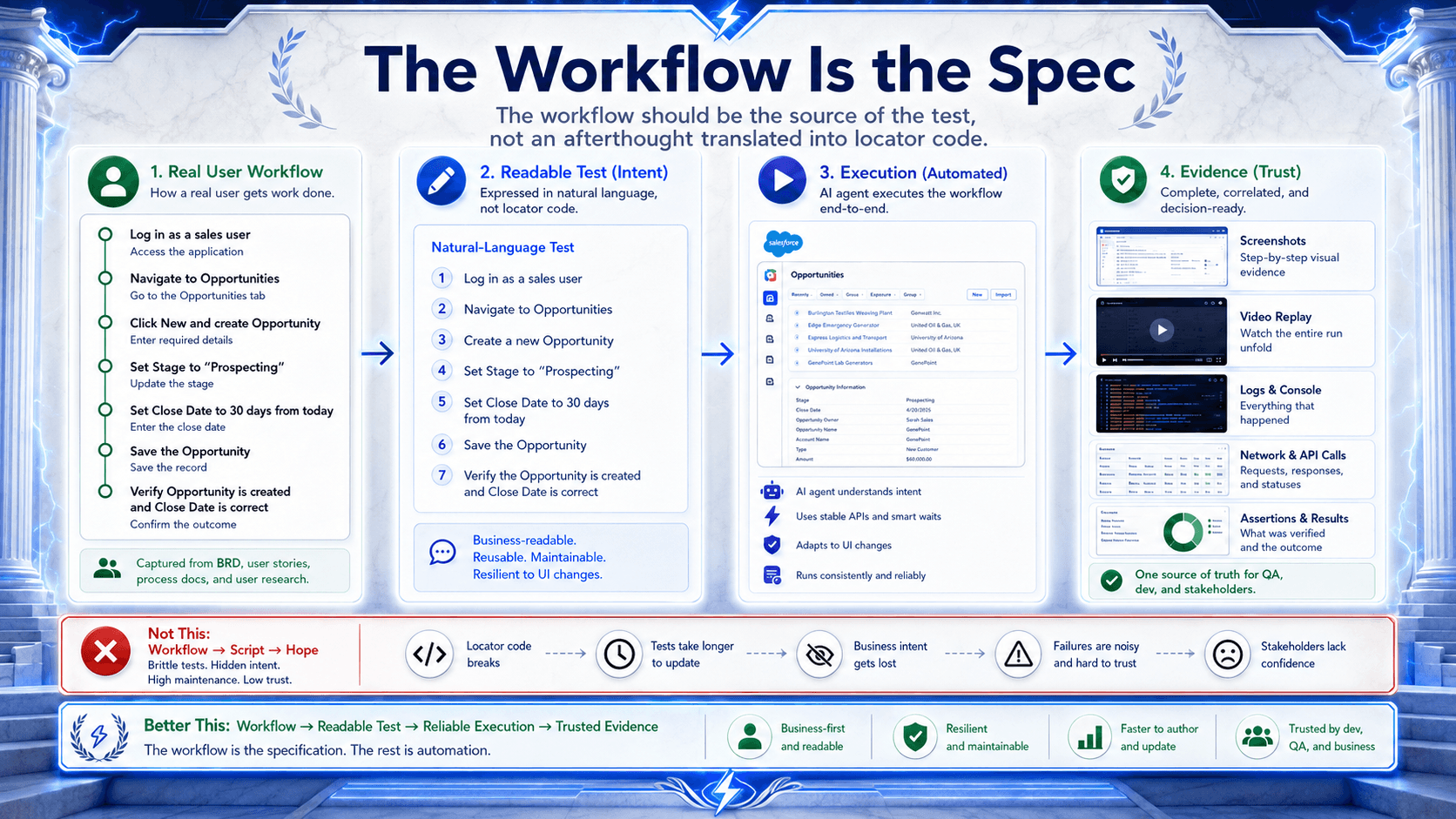
The workflow is the spec.
Not the XPath. Not the CSS selector. Not the page object. Not the Jira ticket written after someone manually checked the feature.
The workflow.
A real user does not think, “Find //button[3] and click it.” A real user searches for a product, chooses a size, adds it to a bag, and expects checkout to keep moving.
Traditional automation begins after that knowledge has already been expressed by a human. A tester performs the workflow, writes it down, hands it over, and waits while someone else reconstructs it in code.
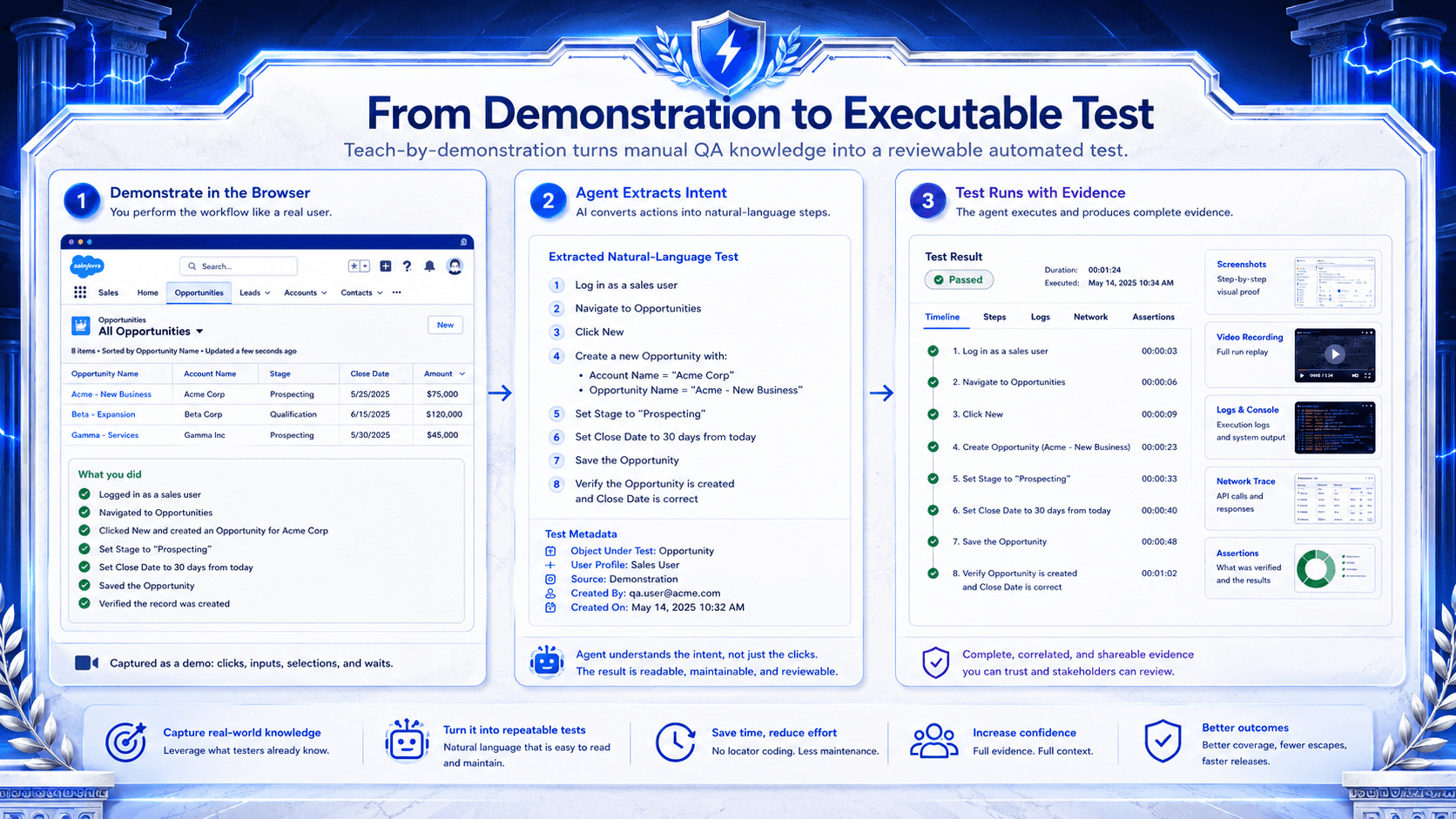
Workflow-based test automation changes the starting point. The tester performs the flow once, inside the browser, and the system learns from the demonstration.
That matters because the browser is not just where the test runs. It can be where the test is born.
The useful output is not a video of clicks. It is a readable, editable, executable test that still carries the intent of the original workflow.
Script-First Testing Makes QA Wait
Most automation backlogs do not start because teams lack ideas. They start because the people who know the workflow are not always the people who write the automation.
Manual testers know where users hesitate. Product owners know which paths protect revenue. Business testers know the difference between a cosmetic change and a broken process.
But the automation queue often waits for someone who can translate that knowledge into locators, waits, assertions, test data, browser setup, and debugging logic.
That handoff is expensive because it recreates knowledge the team already had.
No-code test automation became popular because teams wanted to remove that bottleneck. The stronger version of that idea is teach-by-demonstration testing: do not ask the tester to describe the flow to a tool from outside the product. Let the tester show the flow where the work actually happens.
Manual testers should not have to wait for automation engineers every time a known business path needs coverage.
Locator-First Tests Break for the Wrong Reason
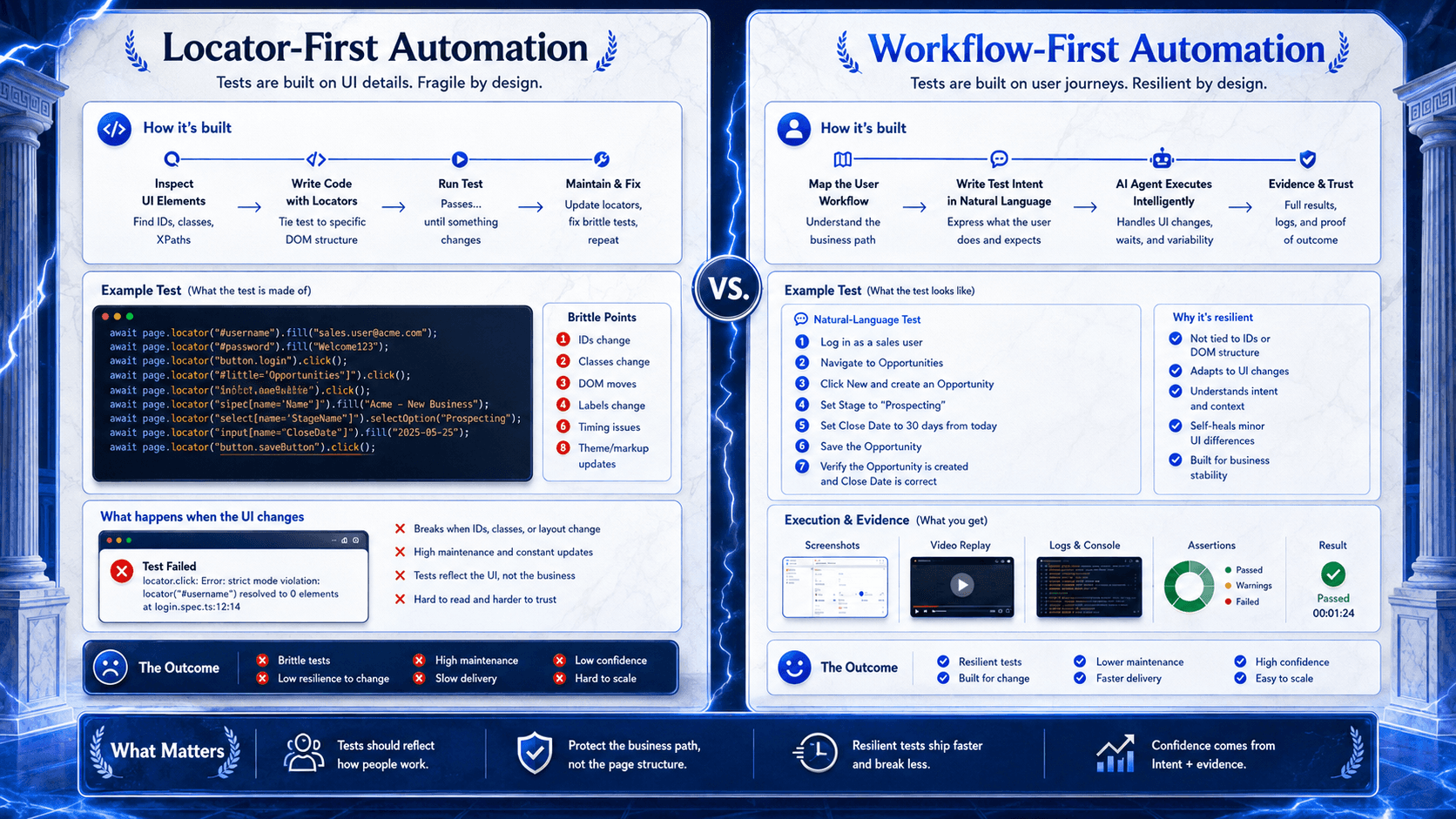
The outdated belief is that good UI automation starts with writing robust locators.
It does not.
Good UI automation starts with understanding the user workflow. Locators are implementation details.
XPath test maintenance becomes painful because UI tests often fail for reasons users would never notice. A label changes. A dynamic ID refreshes. A modal shifts the layout. A component library update changes the DOM shape.
The user can still complete the workflow. The test cannot.
That is not always a product failure. Sometimes it is a recognition failure.
A red test is useful only when it failed for the same reason a user would fail.
This is why flaky UI tests erode trust so quickly. Once a team learns that red often means “selector broke,” not “workflow broke,” the regression suite becomes background noise.
And background noise does not protect releases.
Why Old Recorders Disappointed Teams
Record-and-playback tools were not wrong to start in the browser. They were wrong to stop at clicks.
Classic recorders captured what happened mechanically: click here, type there, wait, submit. The output was often noisy, brittle, and hard to review.
That created a new problem. The test was faster to generate, but slower to trust.
Teams still had to clean up selectors, remove duplicate steps, add assertions, rename actions, handle dynamic elements, and explain what the test was actually proving.
Recording clicks is easy. Recovering intent is the hard part.
This is the difference between an AI test recorder that captures a session and a workflow-first system that turns a demonstrated path into a reusable test.
The first records motion. The second preserves meaning.
Demonstration Beats Translation
The fastest path from manual test to automated test is not a ticket. It is the workflow itself.
A tester already knows what matters. Search for the item. Select the product. Pick the size. Add it to the bag. Confirm the system behaved correctly.
The application is the best surface for expressing that knowledge because it contains the real states, real labels, real timing, and real user choices.
Teach-by-demonstration testing turns manual knowledge into automation without forcing the first step to be code.
That does not remove engineering judgment. It moves engineering judgment to a better place: reviewing intent, strengthening assertions, handling edge cases, and improving coverage.
The fastest test script is the one you never write.
Natural-Language Tests Make Automation Reviewable
Natural language test automation matters because test intent should be readable by more than the person who wrote the script.
A QA lead should be able to review the business path. A product owner should recognize the workflow. A manual tester should be able to say, “Yes, that is what I meant.”
In the TestZeus Teach Agent demo, the tester demonstrates a Nike flow in the browser: search for “nike air max,” open Nike Air Max Dn Roam, add it to the bag, choose a size, and submit the taught workflow with a learning identifier.
The generated test becomes a simple-language case: “Search And Add Nike Air Max To Bag.”
That small shift matters.
The test is no longer trapped inside locator code. It becomes something the team can inspect before it becomes something the system executes.
Self-Healing Is Useful Only If Intent Survives
Self-healing test automation can help when a button moves, a label changes, or a layout shifts.
But healing is only valuable when the system still validates the same workflow.
A test that silently clicks the wrong element is not resilient. It is dangerous.
Self-healing should protect the workflow, not hide a broken test.
That is why evidence matters. If an agent adapts, teams need logs, screenshots, recordings, and execution traces that show what changed, what was clicked, and why the run still represents the intended path.
Human review is not a weakness in agent-assisted testing. It is how teams keep trust.
Evidence Turns a Demo Into a Test
A demonstrated workflow should not remain a black-box recording.
The recording shows what happened. The evidence explains whether it mattered.
Logs help engineers understand where execution moved from expected to unexpected. Screenshots show page state. Recordings reveal timing and visual behavior. Step evidence connects the natural-language test to the actual browser run.
That evidence is what separates a useful automated test from a clever demo.
QA teams do not need another artifact that says “failed.” They need enough context to decide whether the application failed, the environment failed, the data failed, or the automation needs review.
What This Looks Like in TestZeus
At TestZeus, the Teach Agent Chrome Plugin reflects this workflow-first model.
In the demo, the tester installs the Chrome plugin, enters Teaching mode, and performs a real journey on the Nike homepage. The tester searches “nike air max,” opens Nike Air Max Dn Roam, clicks Add to Bag, selects a size, and adds it again.
The steps are mapped while the tester works.
After submission, the tester adds the learning identifier “nike air max.” Inside the TestZeus platform, the Teach Agent page shows the generated workflow: “Search And Add Nike Air Max To Bag.”
The tester creates a natural-language test case without writing manual locators, scripts, or test steps.
Then the test runs through Live Test. The system provides logs, screenshots, recordings, execution evidence, and adaptation when small UI changes occur.
The useful part is not that the clicks were recorded.
The useful part is that the workflow became a reviewable, executable test.
The TestZeus Perspective
At TestZeus, we believe test creation should start where user knowledge lives: inside the workflow.
Teach Agent reflects a simple idea: demonstrate the business path once, convert it into a readable automated test, and let the agent handle execution evidence and UI resilience.
That is the broader shift.
From locator-first automation to workflow-first automation.
From script maintenance to test supervision.
From asking QA to translate what they already know to letting the system learn from the way users actually move.
Stop Turning User Journeys Into Locator Code
Teams should stop forcing every user journey through the bottleneck of locator code.
If a tester can perform the workflow, the system should help turn that workflow into an executable test.
That does not mean locators disappear. It means they stop being the starting point.
The test should know what the user is trying to do, not just where the button lived yesterday.
Explore how TestZeus thinks about workflow-first test creation.
Nutanix moved to this workflow-first model, building tests from real user journeys with TestZeus instead of locator scripts.
3. FAQ Section
1. What is workflow-based test automation?
Workflow-based test automation creates automated tests from real user journeys. A tester demonstrates a business flow in the browser, and the system converts that demonstration into a reusable, executable test.
2. How is teach-by-demonstration different from old record-and-playback testing?
Old recorders captured clickstreams. Teach-by-demonstration testing captures the workflow, extracts intent, and turns the session into a readable test that teams can review, edit, execute, and debug.
3. Why do XPath-based UI tests break so often?
XPath-based UI tests often depend on DOM structure, labels, element hierarchy, or dynamic attributes. When the UI changes, the business workflow may still work, but the test can no longer recognize the page correctly.
4. Can manual testers create automated tests without writing code?
Yes. In workflow-first and no-code test automation, manual testers can demonstrate a workflow in the browser and let an agent convert it into a natural-language automated test. Engineers can still review, refine, and extend the test.
5. What should self-healing test automation prove before you trust it?
Self-healing test automation should prove that it preserved the original workflow. It should provide logs, screenshots, recordings, and step-level evidence so teams can confirm the system adapted correctly.
// Start testing //