Your Salesforce CPQ Flow Is Too Important for Brittle Tests
Short answer: Salesforce CPQ testing is hard because quote accuracy depends on business rules, pricing logic, discounting, approvals, templates, and downstream handoffs, not just page clicks. Traditional UI scripts often break on Lightning complexity like Shadow DOM and still miss the bigger problem: a quote can be technically “passed” in the UI and still be commercially wrong.
A quote does not usually break loudly.
It breaks quietly through a price rule that fired in the wrong order, a discount that appeared when nobody expected it, an approval threshold that stopped routing, or a quote template that rendered the wrong commercial terms after release. By the time someone notices, the issue is not a failed test. It is a bad deal, a delayed quote, or a trust problem between Sales Ops, QA, and the business.
That is why Salesforce CPQ is such a trap for conventional automation. On the surface, it looks like a quoting screen. Underneath, it behaves like a revenue engine.
And in many orgs, it is also, quite literally, “beautiful on the outside, Shadow DOMs on the inside.”
What Salesforce CPQ testing actually means
Most teams still talk about CPQ testing as if it were a web-form problem. Open the quote. Add a product. Change a field. Save. Assert a total.
That is not enough.
A real CPQ regression flow stretches across account context, opportunity setup, product and bundle selection, configuration rules, pricing rules, discount schedules, approvals, quote document generation, and downstream quote-to-cash handoffs. A “green” UI run can still hide a broken commercial outcome if the wrong rule produced the right-looking screen.
For a QA engineer, that means the challenge is not just finding the button inside a messy DOM. It is proving the commercial logic held together.
For testers, that creates a second problem: they cannot test CPQ well unless they understand the business flow and Salesforce CPQ intricately. A CPQ test is not just “add product and save quote.” The tester needs to know why a product is eligible, which pricing rule should fire, how discounts should behave, when approvals should trigger, and what the final quote should represent commercially.
That level of domain knowledge is hard to scale across QA teams, especially when Salesforce CPQ implementations are heavily customized.
The challenge becomes even bigger as teams plan or execute migration from Salesforce CPQ to Revenue Cloud. Migration is not just a platform change. It means validating whether products, pricing logic, approvals, quote outputs, and downstream revenue workflows still behave correctly in the new system. Any gap in test coverage can turn into broken quoting, incorrect pricing, or delayed sales cycles.
TestZeus helps solve this by reading Salesforce metadata and the connected codebase to understand how the org actually works. It can use that context to generate more accurate tests around business flows, configuration, custom logic, and CPQ-specific behavior. This reduces the dependency on every tester manually knowing the full CPQ implementation before they can create useful regression coverage.
This way, teams can test not only whether the UI works, but whether the business logic behind Salesforce CPQ and Revenue Cloud continues to work as expected. For a Salesforce admin or QA leader, it means the riskiest release is often not code. It is configuration.
The real problem: CPQ is a business-rule engine disguised as a UI workflow
This is the stale belief worth retiring:
CPQ testing is just another UI automation problem.
It is not.
CPQ is a chain of revenue decisions. Product eligibility affects quote lines. Quote lines trigger pricing behavior. Pricing behavior changes discounts. Discounts trigger approvals. Approvals affect timing. Templates affect what the customer actually sees. Then renewals, amendments, orders, or billing inherit whatever logic made it through.
Treat that like a normal screen automation project and you get brittle scripts plus false confidence.
Selenium can click Salesforce CPQ. That does not mean it can test Salesforce CPQ.
Why brittle automation keeps losing this fight
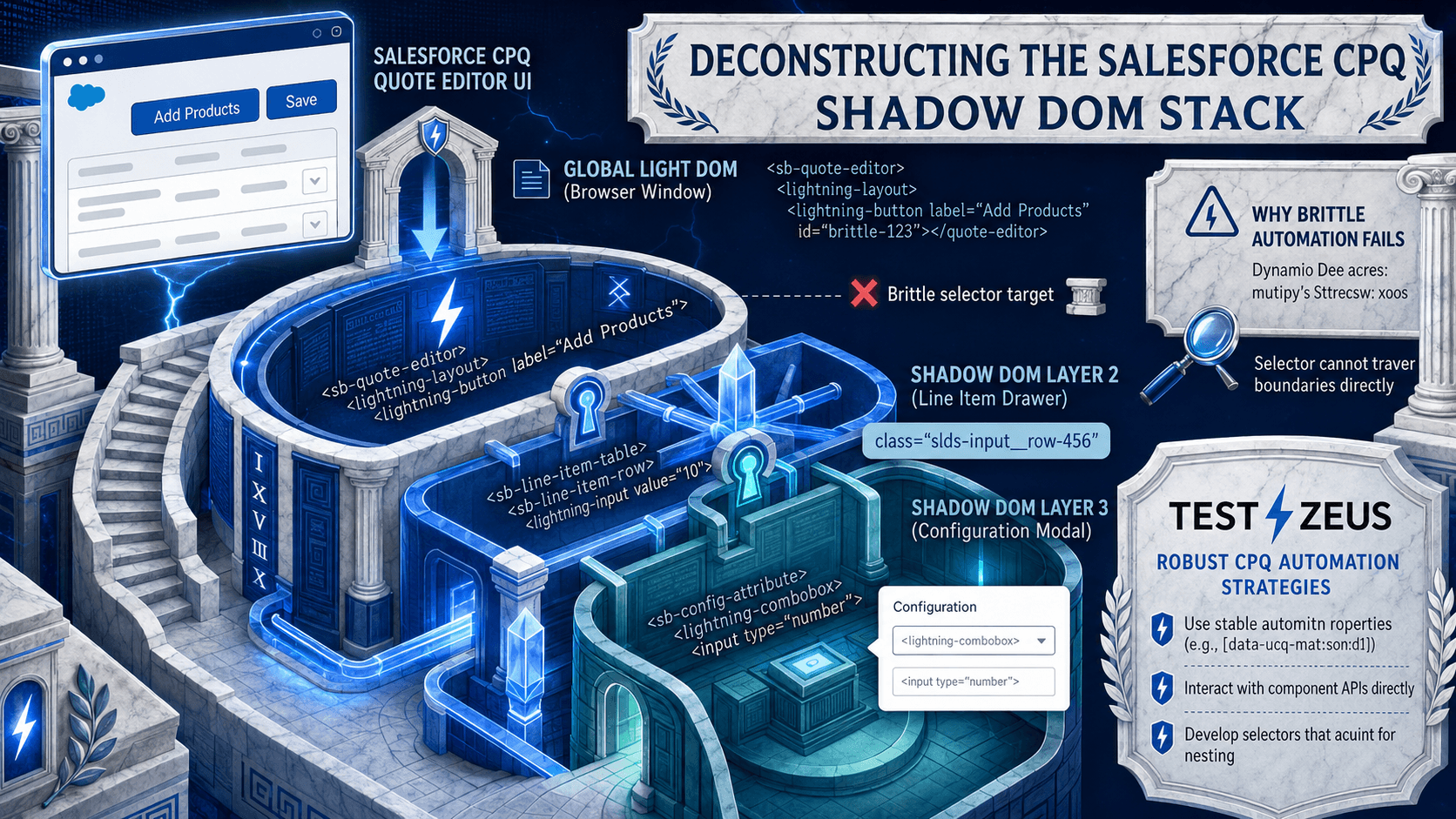
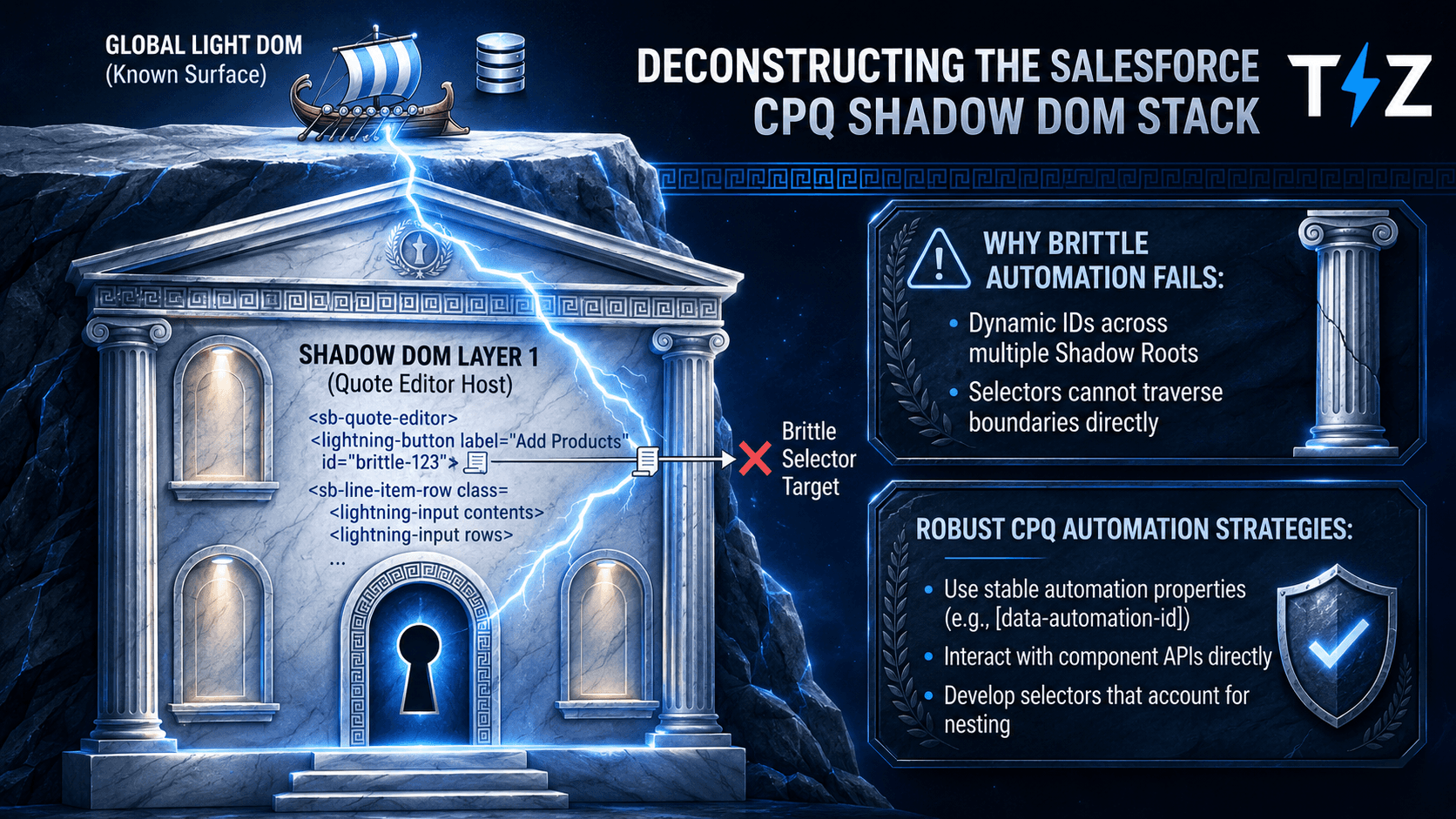
Salesforce’s own Lightning Web Components documentation is blunt about Shadow DOM: component internals are intentionally encapsulated, which makes tests that rely on global DOM access or internal markup more fragile (Salesforce Developers, Salesforce Developers). In plain English: the structure your script wants to depend on is exactly the structure Salesforce does not want you depending on.
That matters in CPQ because the Quote Line Editor is not a simple page. It is dense, dynamic, and often heavily customized. In the TestZeus CPQ demo, key fields are buried under multiple Shadow DOM layers and iframe-heavy UI patterns. That is not unusual. It is what many teams are dealing with.
Even vendors in the space acknowledge the problem. Provar’s CPQ testing guidance explicitly says Salesforce CPQ can be difficult to test with standard automation methods like Selenium and notes that CSS locators become brittle and complex (Provar). BrowserStack’s CPQ testing guide also frames CPQ validation as a mix of functional testing, integration testing, regression testing, UAT, and performance testing rather than a narrow UI exercise (BrowserStack).
That is the heart of it: teams are using tools and test models optimized for web interaction to validate systems driven by business logic and commercial rules.
What teams in the community keep running into
The public threads around Salesforce CPQ sound remarkably similar.
On Salesforce Stack Exchange, teams ask how to understand which price rules fired on a quote line and in what order because debugging “plausible but wrong” prices through the UI is painful (Salesforce Stack Exchange). Other threads describe price rules overwriting values users entered in the Quote Line Editor instead of preserving intended changes (Salesforce Stack Exchange).
The language is familiar to anyone who has lived in CPQ:
“The quote total looks wrong, but I cannot tell which rule caused it.”
“The UI passed, but the quote is commercially wrong.”
“Admins know the rule logic, but QA owns the automation.”
That last one matters more than it looks. In many Salesforce teams, the people who understand why pricing should work are not the same people maintaining brittle automation suites. The result is a handoff gap. Business logic lives in one head. Test implementation lives in another. Confidence lives in neither.
Why this gets worse with every Salesforce release
Salesforce delivers major releases three times a year, each with hundreds of changes across the platform (Trailhead, Salesforce Releases). Even if your CPQ implementation itself is stable, your operating environment is not.
That is why CPQ regression suites rarely “fail suddenly.” They decay slowly, one selector, one environment, and one ignored flaky test at a time.
And there is another market shift worth paying attention to: Salesforce’s own current CPQ developer guide now points customers toward Revenue Cloud for a more comprehensive path forward (Salesforce CPQ Developer Guide). Whether a team stays on legacy CPQ for years or starts evaluating successor revenue workflows, the testing challenge does not disappear. If anything, it broadens. You are still validating revenue logic, approvals, documents, and end-to-end outcomes.
A more useful model: test revenue flows, not just screens
Here is the shift smart teams need to make:
Stop asking, “Did the script click through the quote?”
Start asking, “Did the system produce the right commercial result, with evidence?”
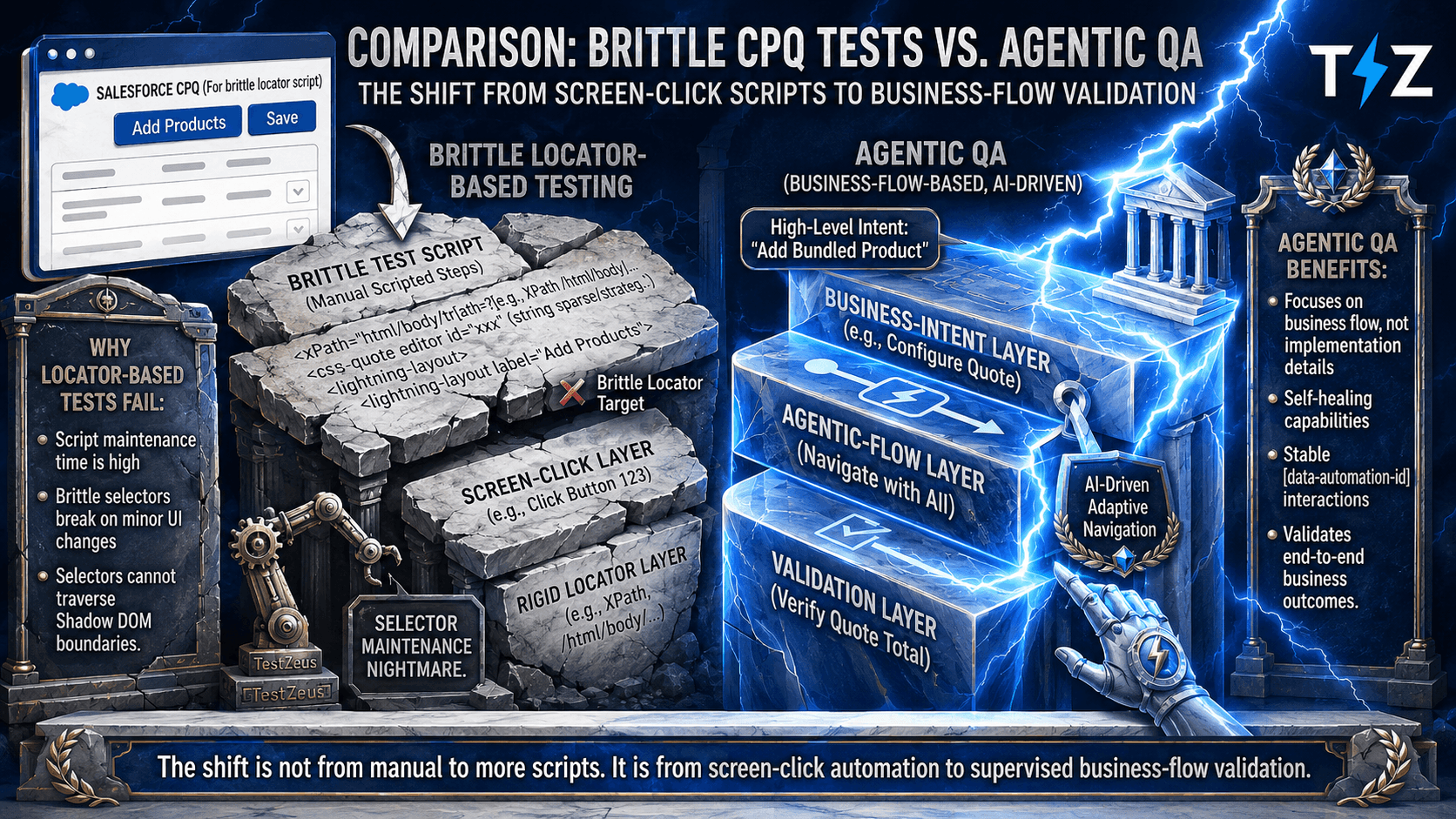
That changes the unit of testing from UI steps to business intent.
Instead of writing tests that only say:
“Click Edit Lines, add product, save.”
You want test intent that says:
“Create an opportunity, generate a quote, add Product A, preserve the prior quote total, validate the recalculated total, verify discount behavior, and confirm the evidence.”
That is why natural-language, agent-supervised testing matters in CPQ. It lets teams express the business flow in a form admins, business testers, and QA can all read, while still producing execution artifacts and validations that engineering leaders can trust.
A practical framework for Salesforce CPQ test coverage
CPQ phase | What usually breaks | What a weak test misses | What a strong test validates |
Account, contact, opportunity setup | Missing context, bad record dependencies, bad test data | The test never reaches the real business path | Whether the quote journey starts with valid commercial context |
Product and bundle selection | Invalid combinations, missing options, wrong defaults | A field was clicked, but the bundle logic was wrong | Whether the right products, constraints, and dependencies were applied |
Pricing and discounts | Price rule collisions, overwritten values, stale summary variables | The total changed, but nobody knows why | Whether the expected pricing path produced the expected result |
Approvals | Thresholds not triggering, wrong routing, exceptions skipped | A quote saved successfully | Whether the right approval path was enforced |
Quote documents | Wrong terms, missing line items, stale template content | The UI total looked fine | Whether the customer-facing output matches the intended deal |
Renewals and downstream handoff | Broken continuity into orders, contracts, or amendments | The quote itself passed | Whether the revenue workflow holds beyond the quote screen |
If a team wants one simple rule, use this:
Every CPQ regression test should prove one business outcome, not just one UI interaction.
The TestZeus perspective
This is where TestZeus fits the category shift well.
Another reason CPQ testing breaks down is the lack of domain expertise inside the automation layer.
Salesforce CPQ is not just a page with fields. It is full of org-specific metadata, custom objects, Apex code, validation rules, flows, triggers, price rules, product rules, quote templates, and approval logic. A tester may understand the expected business outcome, but not always know which Salesforce configuration or customization is responsible for it. An automation engineer may understand selectors and scripts, but not the CPQ domain well enough to design accurate regression coverage.
That gap creates weak tests.
TestZeus helps close it by reading Salesforce metadata and the connected codebase to understand how the org actually behaves. Instead of relying only on generic instructions or manual domain transfer, TestZeus can use the underlying Salesforce configuration, metadata, and implementation context to generate more accurate tests for CPQ workflows.
This means teams are not just automating clicks. They are creating tests that better reflect the real business rules inside their Salesforce environment.
That is a useful signal for where testing is going.
The future of Salesforce QA is not endless script maintenance. It is agent supervision. Human teams still decide what matters. They still define the revenue logic worth protecting. But the execution layer no longer has to be locked inside brittle selectors and specialist-only automation code.
Practical takeaways
Stop treating CPQ as a form-testing problem. It is a revenue-validation problem.
Reframe your regression suite around business outcomes like pricing, discounting, approvals, and quote accuracy.
Pull Salesforce admins and business testers closer to test design. They often understand the commercial logic better than the automation layer does.
Make evidence part of the test requirement. A passed run should explain what happened, not just that something clicked.
Prioritize end-to-end quote-to-cash paths over isolated UI smoke tests, especially around custom pricing and approvals.
Experian hardened its own Salesforce CPQ testing this way using TestZeus.
FAQs
Why is Salesforce CPQ so hard to automate?
Because the hard part is not just the UI. CPQ behavior depends on layered pricing rules, discounts, approvals, templates, data dependencies, and dynamic Salesforce UI structures like Shadow DOM.
Why do Selenium-based CPQ tests become brittle?
They often depend on locators and DOM structures that shift across Salesforce releases, Lightning component updates, and org-specific customizations. Even when they run, they may still miss business-rule failures.
Is Salesforce CPQ testing mainly a QA engineering problem?
No. It is a shared problem across QA, Salesforce admins, business testers, and release owners because the logic being validated is commercial, not purely technical.
What should a good CPQ regression suite validate?
At minimum: product selection, pricing logic, discounts, approvals, quote totals, template output, and downstream flow continuity.
Does this problem go away if teams move toward Revenue Cloud?
Not really. The surface may change, but the core testing challenge remains the same: validating revenue workflows, business rules, and end-to-end outcomes.
Where does agentic QA help most in CPQ?
It helps where tests need to be business-readable, resilient to UI complexity, and backed by evidence rather than fragile selector logic.
Salesforce CPQ testing is too important to be owned by brittle scripts alone. Teams that treat quote-to-cash as a business flow instead of a click path will end up with better release confidence, faster regression cycles, and fewer “how did this get through?” moments. If that shift is overdue in your org, it is worth taking a hard look at how your current suite defines a passing test. See How TestZeus Tests Salesforce CPQ
// Start testing //