Voice Agents Cannot Be Tested Like Chatbots
A voice agent can give the right answer and still deliver a bad call.
It can pause too long. It can talk over the caller. It can miss an interruption, sound cold when the caller is angry, or lose the thread when the audio gets messy. The transcript may look clean. The customer experience may not.
That is the testing problem Salesforce and Agentforce teams now have to face: voice agents are not chatbots with a phone number.
What is voice agent testing: Voice agent testing evaluates whether an AI voice agent behaves safely, naturally, and reliably during live spoken conversations. It goes beyond transcript accuracy to test latency, interruption handling, noisy audio, emotional response, escalation, sensitive data handling, audio quality, and replayable evidence before release.
A Voice Agent Is Not a Chatbot With Audio
Chat is controlled. The user types, waits, reads, and replies. The agent's failure usually appears in the visible text: a wrong answer, a bad citation, a missed policy, or a broken tool call.
Voice is messier because it happens in real time. A caller interrupts, pauses, mumbles, changes intent halfway through, speaks from a noisy room, or gets frustrated because the issue already took twenty minutes before the agent picked up.
That changes the quality bar. The voice agent has to listen, understand, decide, respond, and recover while still following business rules, Salesforce workflow logic, AI safety policies, and escalation boundaries.
Salesforce positions Agentforce Voice as a way to build voice-enabled agents that manage complex conversations in real time across phone, web, and mobile. That is not a simple Q&A surface. It is a live service workflow.
The Transcript Is Not the Whole Call
Transcript correctness matters. It is useful for QA review, product debugging, compliance analysis, and release notes.
But a transcript is not the call.
The audio may reveal a six-second pause before the agent answered. It may reveal the agent talking over the caller. It may show that the agent technically escalated, but only after frustrating the customer with three irrelevant confirmations.
Logs can explain the model; audio explains the customer experience.
The Voice Experience Gap
The Voice Experience Gap is the difference between a voice agent being textually correct and being operationally, emotionally, and experientially acceptable on a real call.
A correct answer is not the same as a good call.
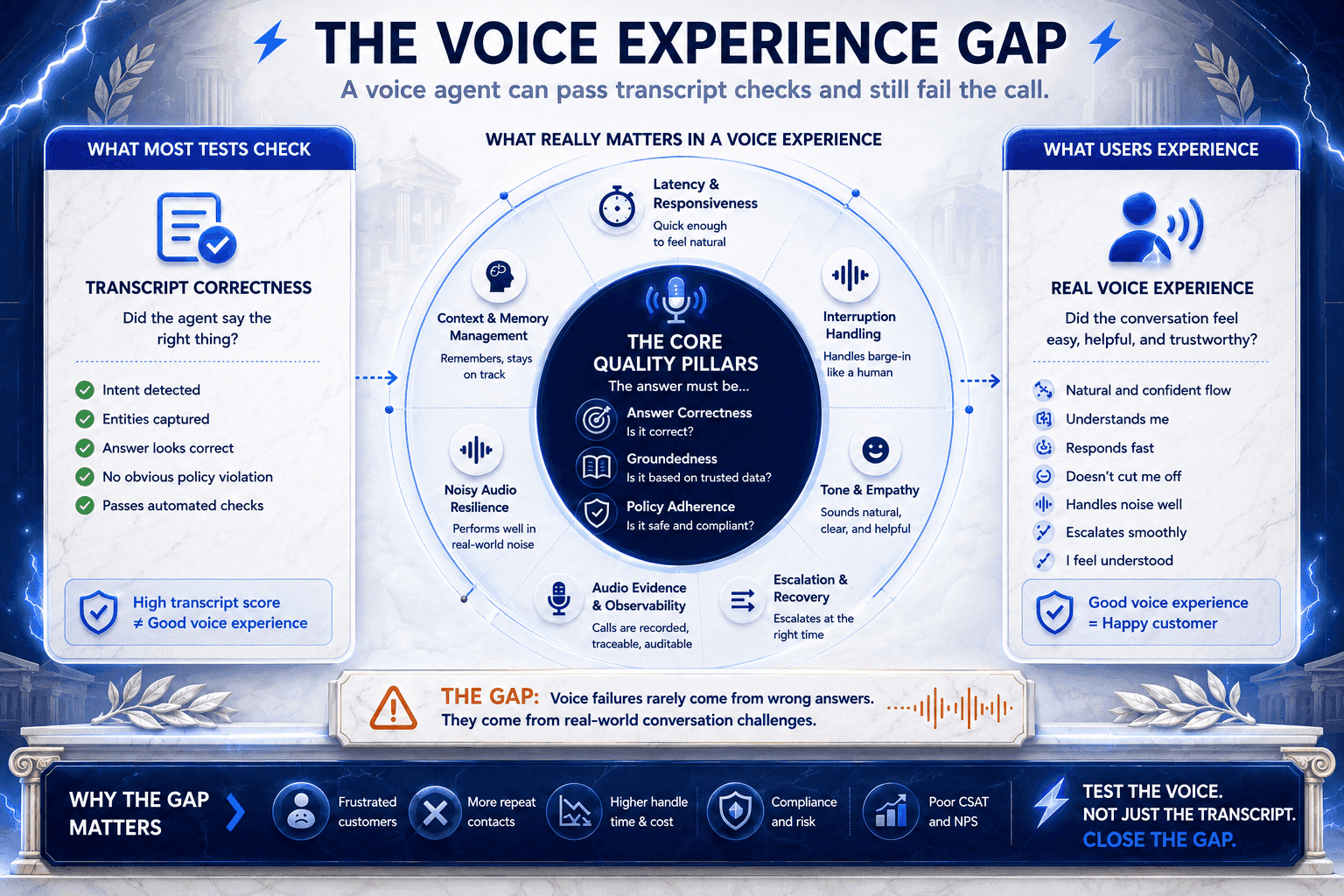
The gap shows up when the answer is correct but late, when the policy is followed but the tone is cold, when the handoff fires but loses context, or when the transcript looks fine while the audio reveals talk-over.
What Scientific Research Says About Voice-Agent Failure Modes
There is not yet a public, peer-reviewed failure-mode dataset specifically for Agentforce Voice. So the responsible way to reason about Agentforce Voice failure modes is to combine Salesforce's public architecture and handoff guidance with broader spoken-dialogue, ASR, voice-agent benchmark, and call-center research.
That research points to a simple pattern: voice failures cluster around interaction mechanics, channel robustness, emotional fit, and governance boundaries. The LLM answer is only one layer.
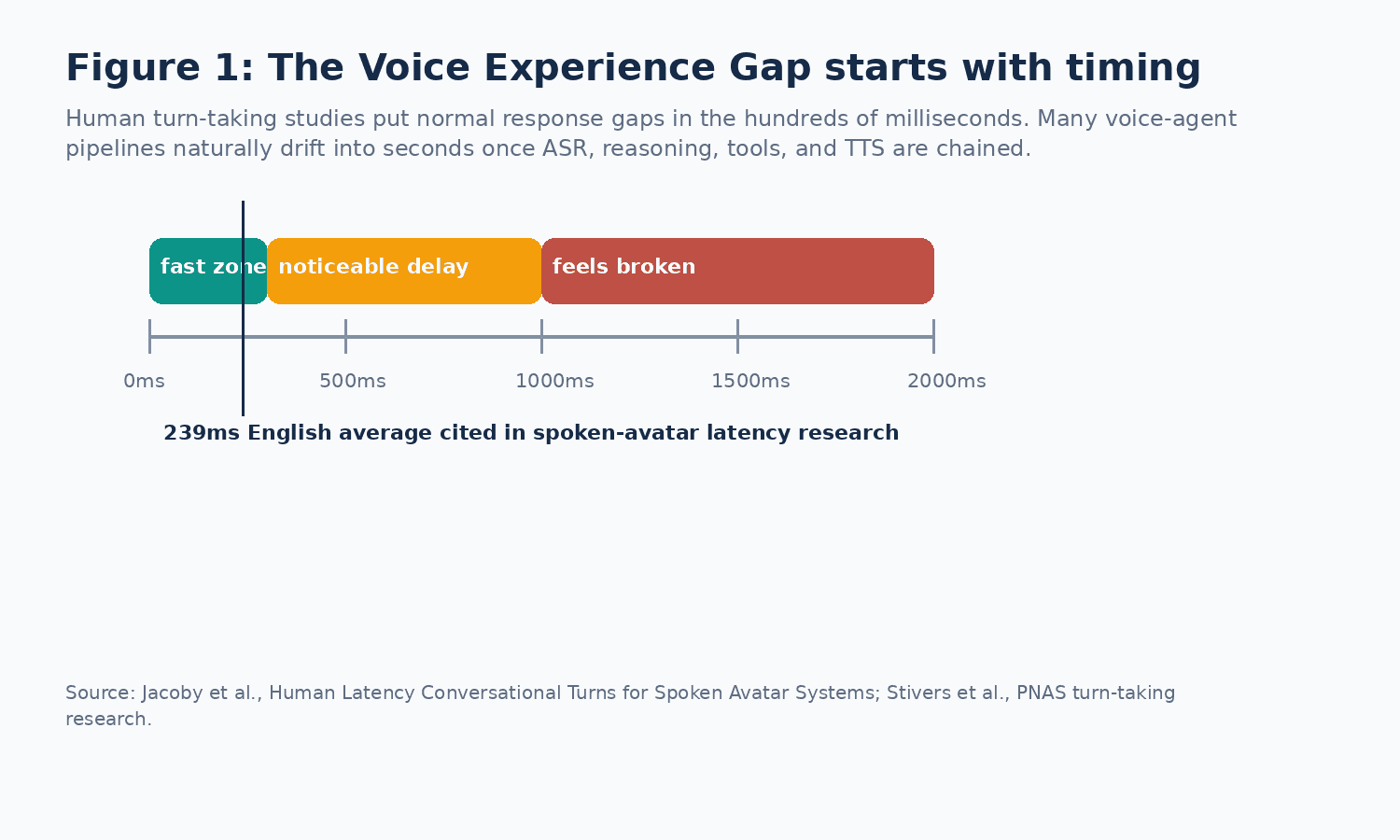
Turn-taking research is especially relevant. A review of conversational systems notes that humans coordinate turns with small gaps and little overlap, while voice assistants and social robots often struggle with interruptions and long response delays. That is exactly why latency and barge-in are QA dimensions, not nice-to-have UX metrics.
Spoken-avatar latency research cites an average English response delay of about 239 milliseconds in human dialogue and argues that serial ASR-to-LLM-to-TTS pipelines struggle to match human timing expectations. This does not mean every enterprise voice agent must answer in 239 milliseconds. It means a two-second pause is not only a backend delay; it is a conversational failure risk.
ASR research adds the channel-risk layer. Noise-robust ASR reviews identify noise and mismatch between training and testing conditions as leading causes of recognition degradation. Accent-related transcription research likewise shows that speech recognition can perform unevenly across speaker groups. For Agentforce teams, that means a clean-office demo is not enough evidence for production voice readiness.
Call-center emotion research adds another dimension. Studies of customer sentiment and communication style show that emotion and response style can materially influence satisfaction and recommendation behavior. In voice, a technically correct answer can still fail if it mishandles frustration, impatience, or escalation pressure.
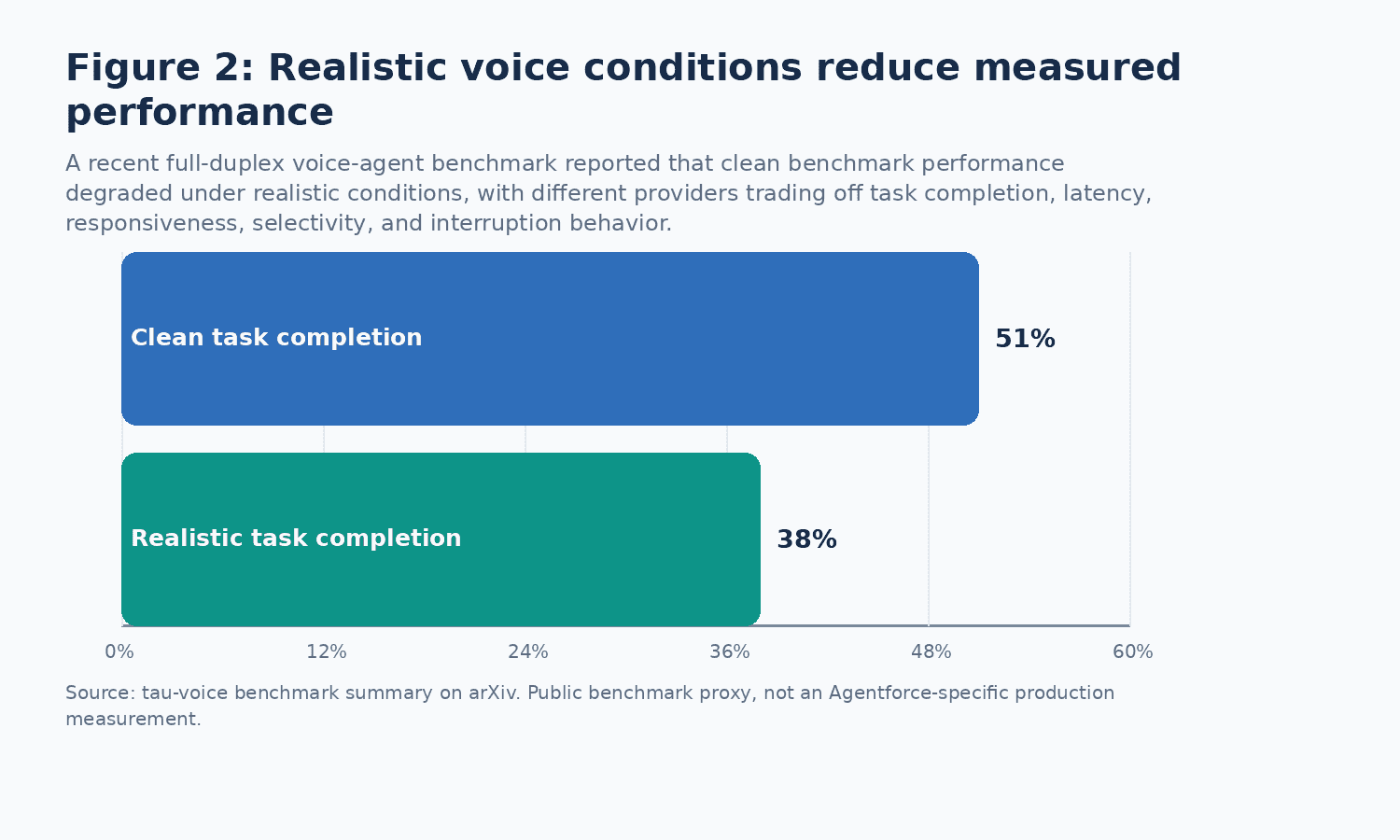
Graph: Research Proxy for Voice-Agent Degradation
The chart below should be used as a research proxy, not an Agentforce production claim. It shows why the blog's category argument is defensible: when voice systems move from clean benchmark conditions to realistic interaction conditions, quality can degrade in ways transcript-only review will miss.
The Failure Modes Agentforce Voice Teams Should Actually Test
The practical test suite should map research-backed failure modes to Agentforce-specific workflow risk. A useful release suite should include:
Latency failures: the agent waits too long, causing the caller to repeat themselves or interrupt.
Turn-taking failures: the agent talks over the caller, misses barge-in, or uses stale context after interruption.
Audio robustness failures: the agent mishears mumbled speech, noisy background audio, accents, or channel distortion.
Intent-drift failures: the caller changes direction mid-call and the agent keeps following the previous task.
Handoff failures: escalation triggers too late, routes incorrectly, times out, or loses context.
Emotional-response failures: the agent stays technically correct but mishandles anger, urgency, or confusion.
Disclosure failures: the agent reveals sensitive data conversationally or fails to enforce policy boundaries.
Evidence failures: the transcript exists, but the audio replay, timing, or diagnostic data is missing or not reviewable.
Practical Agentforce Voice Issues People Are Already Discussing
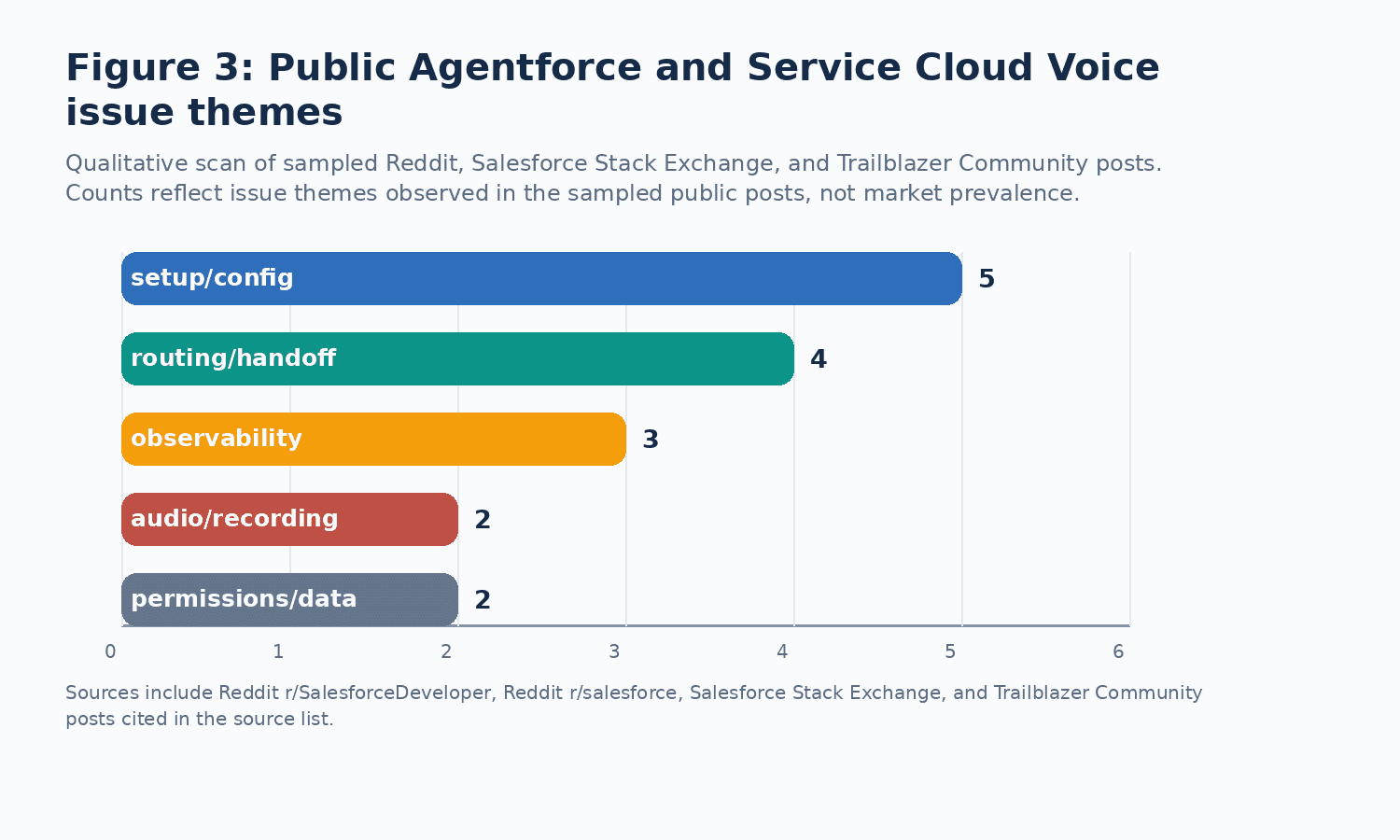
A public scan of Reddit, Salesforce Stack Exchange, and Trailblazer Community does not prove market-wide prevalence. It does show the kinds of issues practitioners are already wrestling with around Agentforce Voice and the surrounding Salesforce voice stack.
One Reddit post from a practitioner who built an Agentforce Voice proof of concept described configuration cliffs such as sessionTimeout=0 causing immediate disconnects, half-failed voice setup attempts leaving undeletable messaging-channel artifacts, hidden UI-created bindings for inbound routing flows, fallback queue requirements, and transfer behavior that depended on the right Omni-Channel setup.
A Salesforce Stack Exchange question on Agentforce in BYOC for CCaaS described escalation requests timing out even after routing events appeared, with little useful debug-log visibility. Another Service Cloud Voice question described a call being accepted in Salesforce but the conversation not starting, leaving the contact on hold.
A Reddit Service Cloud Voice thread reported recurring random voice issues, duplicate-looking calls, CloudWatch/Lambda investigation, and frustration that admins had to become AWS/CloudWatch experts to debug what looked like Salesforce voice behavior. A Trailblazer Community post on call recording showed another operational wrinkle: users could not load recordings until browser and OS microphone settings were corrected.
The point is not that every Agentforce Voice deployment will hit these exact issues. The point is that voice-agent quality lives across a wider system boundary than the agent response: telephony setup, routing flows, session settings, permissioning, recording access, observability, and human handoff all affect whether the call works.
Manual Voice Testing Does Not Scale to Releases
Calling the bot a few times is useful. It helps teams explore the agent, find obvious issues, and understand the feel of the experience.
But it is not release readiness.
Manual call testing is subjective, hard to repeat, and weak against adversarial coverage. One release may pass because the test caller used perfect audio. The next may fail because a real customer called from a car, switched intent, and interrupted twice.
This is not a criticism of QA teams. It is a criticism of the testing model.
Voice Agents Need Adversarial Scenarios, Not Only Happy Paths
Happy paths are polite. Customers are not always polite.
A realistic voice testing strategy should include callers who interrupt, mumble, pause for too long, change their mind, ask the same thing in a different way, speak with background noise, or push the agent to reveal information it should not disclose.
NIST and OWASP both reinforce the need to test adversarial behavior, sensitive information disclosure, and oversight. In voice, those risks do not disappear. They become conversational.
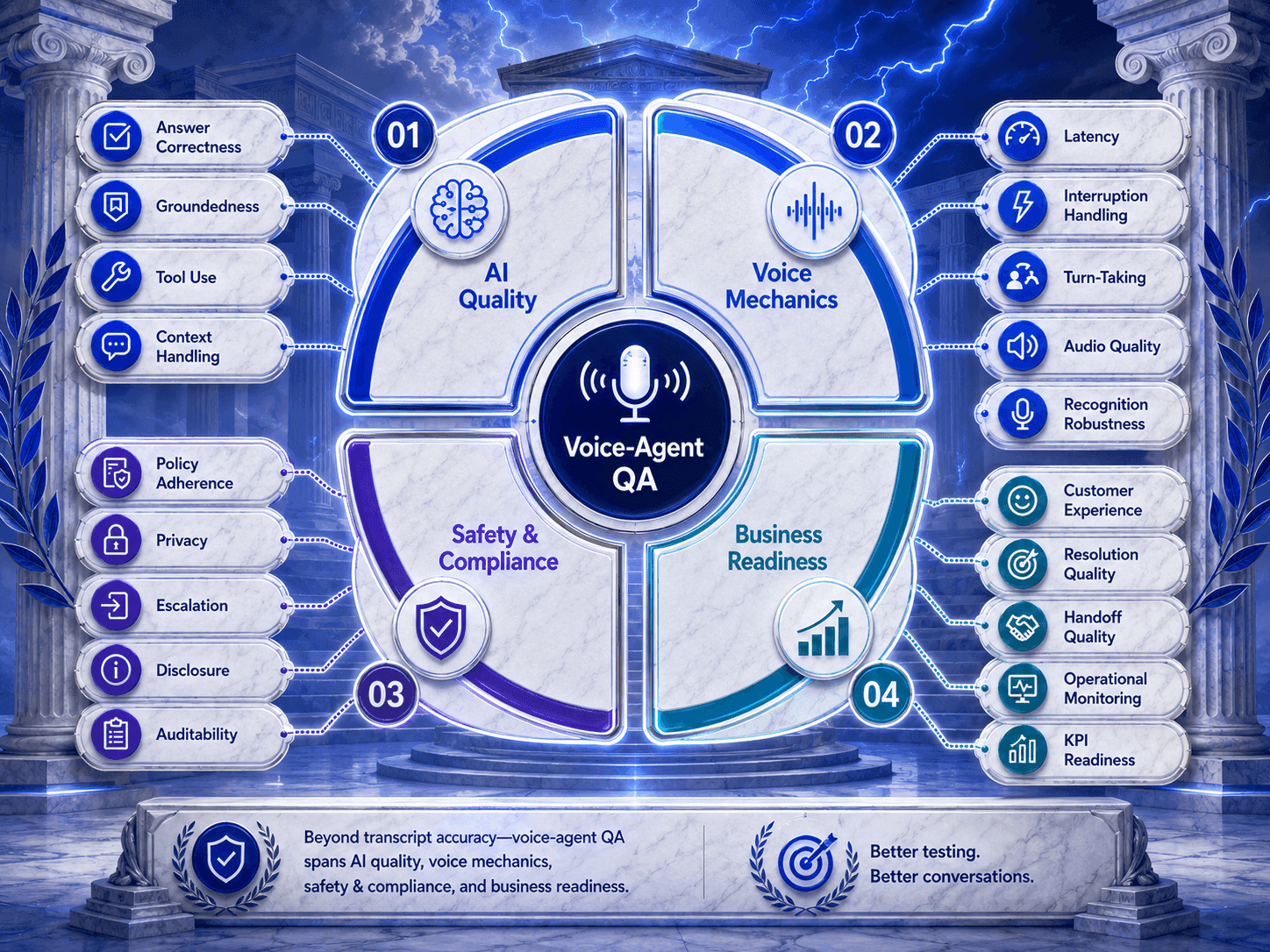
The Dimensions That Decide Voice Quality
A single pass/fail score is too thin for voice.
A voice agent can pass correctness and still fail latency. It can pass policy adherence and fail emotional response. It can pass task completion and fail handoff quality.
Release-ready voice testing needs classic AI quality, voice-experience quality, and business readiness measured together.
Latency Is Not Just a Backend Metric
In text, a delay is annoying. In voice, a delay feels like the agent stopped working.
A slow voice agent creates doubt. Did it hear me? Is it thinking? Did the call drop? Should I repeat myself?
This is why latency belongs in QA, not only engineering dashboards. If response timing changes trust, it is a quality dimension.
Interruption Handling Is Where Voice Agents Often Break
In chat, interruption is easy. The user sends another message.
In voice, interruption is a state problem. The agent has to stop speaking, recognize that the caller has taken the turn, preserve the right context, discard what was never actually heard, and recover without acting confused.
Microsoft's voice interruption guidance highlights a subtle issue: when playback is interrupted, the conversation history must reflect what the user actually heard. Otherwise the system may believe it delivered information that never reached the caller.
Escalation Is a Quality Signal, Not a Failure
Some teams still treat human handoff as defeat. That belief needs to go.
A safe voice agent should know when to stop trying. If authentication is incomplete, policy is tight, confidence is low, the caller is angry, or the workflow has moved into a regulated edge case, escalation may be the best outcome.
The quality question is not only whether the agent escalated. It is whether it escalated at the right time, for the right reason, with the right context preserved.
Sensitive Data Risk Sounds Different on a Call
Voice agents can leak sensitive information conversationally.
A caller may pressure the agent for account details. They may imply authorization they do not have. They may ask the agent to read back information that should be masked. They may mix legitimate requests with social engineering.
Audio evidence helps teams review what happened. It does not, by itself, prove compliance. Human review remains important for high-risk workflows.
Voice Testing Needs Transcript and Audio Evidence
Transcript review is fast. Audio replay is honest.
QA teams need transcripts to search, compare, score, and debug. But audio replay shows timing, tone, overlap, pacing, silence, interruption cuts, and escalation delivery.
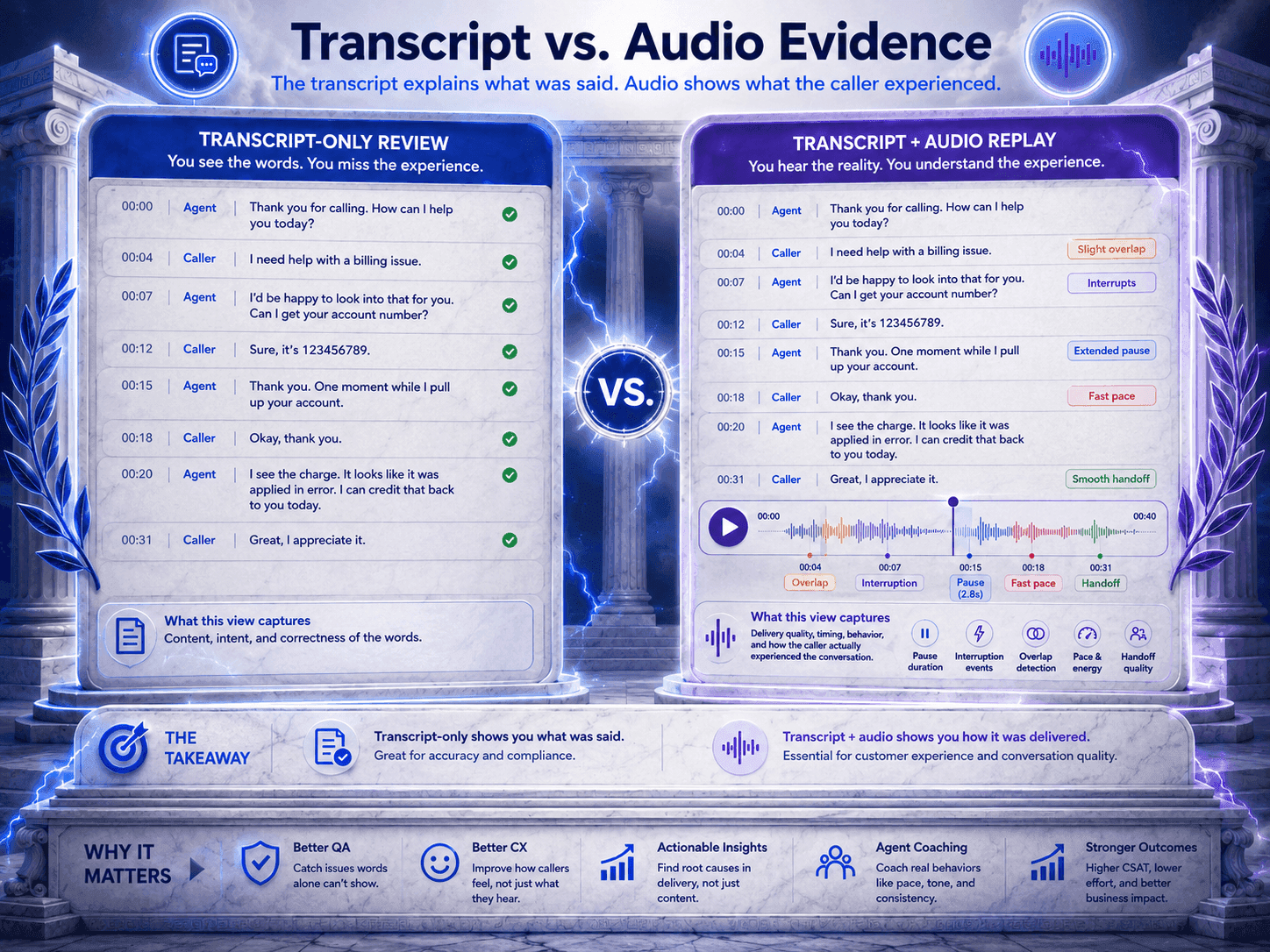
Evidence changes the conversation from opinion to reviewable behavior.
How TestZeus Voice Harness Makes Voice QA Repeatable
This is where TestZeus Voice Harness fits the category problem.
For Agentforce teams, Voice Harness helps move voice QA from manual spot checks to repeatable simulation. Teams can connect Agentforce voice agents, define a testing focus such as information disclosure, generate adversarial voice pathways, and run realistic simulations against the real voice agent surface.
Voice Harness captures transcripts and audio, then scores interactions across AI and voice-experience dimensions such as safety, information disclosure, latency, robustness, interruption handling, resilience, voice naturalness, emotional response, and audio safety.
The point is not to remove human judgment. The point is to give QA, product, compliance, and business teams better evidence before release.
Release-Ready Voice Agents Need Repeatable Evidence
Voice agents will not be tested once and forgotten.
Every meaningful change can move the risk surface: prompt edits, knowledge updates, new flows, model changes, routing logic, policy changes, telephony setup, escalation behavior, or Salesforce release changes.
Manual testing catches anecdotes. Harness testing creates evidence.
A TestZeus Perspective
At TestZeus, we believe testing is moving from script maintenance to agent supervision.
Voice makes that shift obvious. If customers experience the agent through a live call, quality has to include more than transcript inspection. It has to include latency, interruption handling, tone, escalation, noisy-audio robustness, audio evidence, and release-readiness reporting.
The old question was: did the agent say the right words? The better question is: did the agent handle the whole call?
Practical Takeaways
Do not evaluate voice agents with chatbot assumptions. Voice inherits the complexity of agent testing, then adds real-time interaction risk.
Treat transcript accuracy as necessary, not sufficient. A transcript can pass while the audio reveals a poor customer experience.
Build adversarial voice scenarios before release. Test interruptions, noise, mumbles, frustration, intent switching, escalation pressure, and sensitive-data attempts.
Measure the Voice Experience Gap. Look at latency, interruption recovery, emotional response, handoff quality, audio quality, policy adherence, and release evidence together.
For voice agents, the call is the test.
FAQ Section
What makes voice-agent testing different from chatbot testing?
Voice-agent testing evaluates a live spoken interaction, not just a written response. Chatbot testing can focus heavily on transcript correctness, tool use, and policy adherence. Voice testing also has to measure latency, interruption handling, noisy audio, tone, pacing, escalation quality, and whether the caller actually experienced a good call.
Why is transcript accuracy not enough for voice QA?
A transcript can show the right words while hiding a bad call. The agent may have paused too long, talked over the caller, mishandled an interruption, sounded cold, or escalated poorly. For voice QA, audio replay matters because timing, overlap, delivery, and emotional tone are part of the customer experience.
How do you test latency and interruption handling in voice agents?
Teams should run repeatable voice simulations that measure response timing, turn-taking, barge-in behavior, and recovery after interruptions. Good tests should verify whether the agent stops speaking, listens, preserves the correct context, and responds without relying on stale or undelivered information.
What should Agentforce teams measure before releasing a voice agent?
Agentforce teams should measure answer correctness, policy adherence, information disclosure, latency, interruption handling, noisy-audio robustness, emotional response, escalation accuracy, handoff quality, audio safety, transcript evidence, audio replay, and regression performance across releases.
Why do voice-agent tests need audio replay and audit evidence?
Audio replay helps teams verify what the caller actually experienced: timing, tone, silence, talk-over, interruption cuts, and handoff delivery. Transcript and audio evidence together help QA, product, compliance, and business teams review failures, compare releases, and make better release-readiness decisions.
Watch a sample voice-agent test run. (Right-click the video and open it in a new tab to hear the audio.)
// Start testing //