Natural Language Testing Is Really Intent Automation
Short answer: Natural language testing is a way to write automated tests in business language instead of code. A tester states the workflow, such as creating a Salesforce lead or rejecting a bad phone number, and an AI agent executes it, captures evidence, and reports the result. The real shift is not less rigor. It is making test intent directly executable.
Creating a Salesforce lead is simple.
But the automation is anything but simple. That is where teams hit the wall: turning one business sentence into selectors, waits, framework code, test data, assertions, screenshots, and maintenance tickets after the next Salesforce release.
That gap has a cost.
Call it the translation tax.
The Translation Tax Is What Breaks Modern QA
Traditional automation asks teams to translate business intent into implementation detail before they can prove anything. The requirement says, “Create a lead and verify it saved.” The test script says, “Find this element, click that button, wait three seconds, fill these fields, assert that toast.” The more the test says about the UI, the less it says about the business.
That is the quiet failure in script-first QA. It is not that code is wrong. It is that business meaning gets trapped inside code.
Once that happens, the test becomes hard to review outside the automation team. Product can no longer verify coverage. Salesforce admins can no longer sanity-check whether the workflow still matches the org. Manual testers may know exactly where the edge cases are, but they still need someone else to translate those cases into Selenium or Playwright.
That translation step is not just slow. It is lossy.
If the business cannot read the test, you have already lost intent.
Salesforce Makes the Tax More Expensive Than Most Teams Admit
Ask a Salesforce QA lead what happens after a seasonal release and the answer is rarely elegant. A suite that looked fine last week suddenly starts going red. Not because the workflow changed, but because the page did.
Salesforce is unusually good at making brittle automation feel expensive. Its UI surface shifts with configuration, profiles, record types, validation logic, Lightning components, and seasonal platform updates. Salesforce’s own developer guidance warns that Lightning and Shadow DOM structures make UI testing harder than it looks, and that low-level DOM assumptions do not age well in end-to-end automation (Salesforce Developers: UI Test Automation on Salesforce, Salesforce Developers: Test Lightning Web Components).
That is why locator maintenance becomes a job in itself. QA Wolf’s breakdown of Salesforce testing challenges points to dynamic DOM structure, data constraints, and exploding configuration paths as structural causes of fragile tests. In community threads, testers say the same thing in plainer language: even small UI changes can blow up a suite, and too much time disappears into locator repair instead of real validation (Reddit: Selenium tests breaking constantly after every UI change, Reddit: Structural XPath locators are killing your test stability).
The hard part is not writing a Salesforce test.
The hard part is keeping the test alive after the org changes.
Natural Language Testing Matters Because It Keeps Intent Visible
Natural language testing is easy to misunderstand.
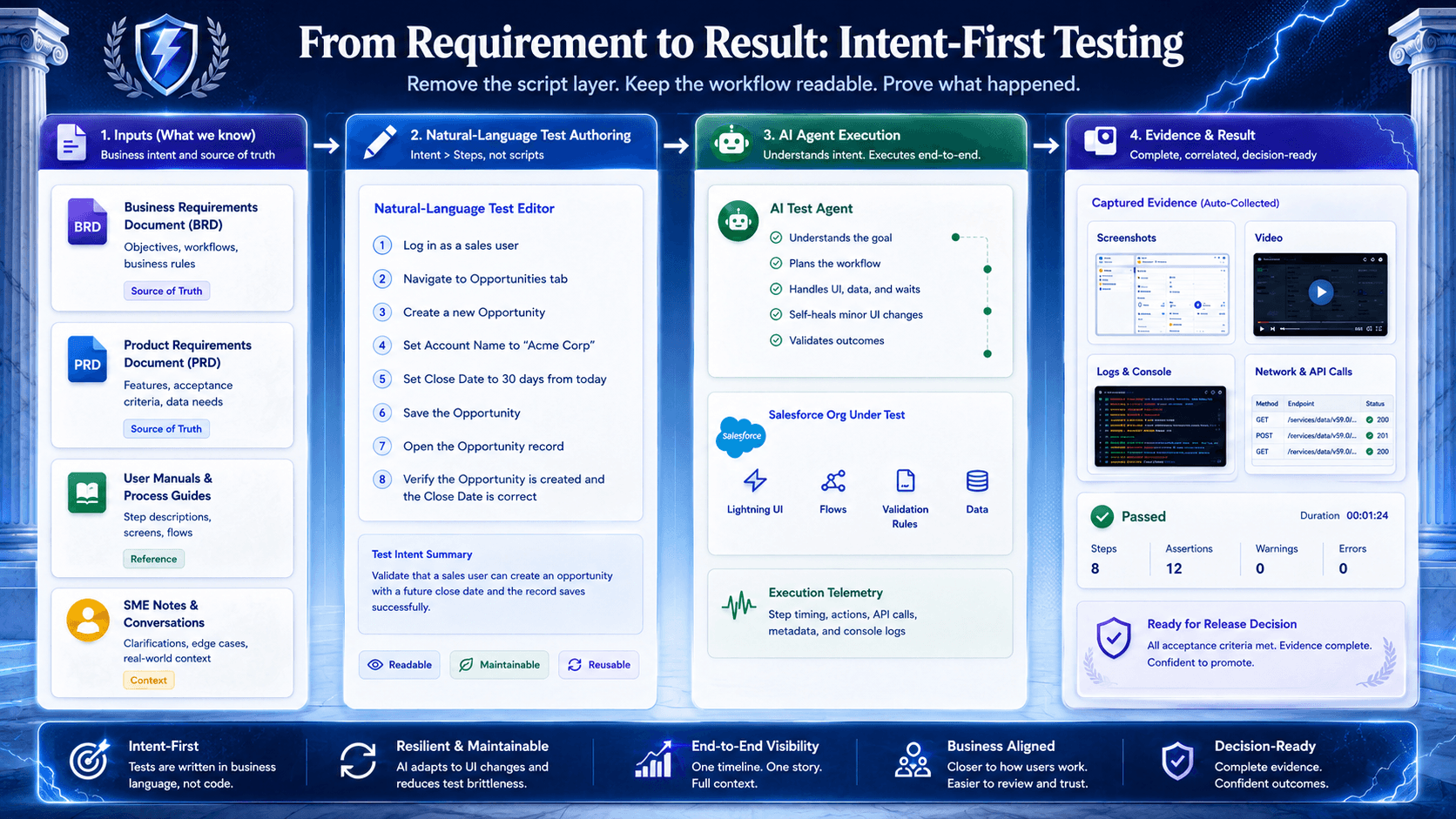
The point is not that QA gets less technical. The point is that the test stays closer to the requirement. Instead of burying the workflow under framework code, the team can express it directly: create negative tests for account creation. Account creation using a bad phone number. Log into the leads URL, click New, enter salutation as Dr., append the current time to the first name, save, verify the lead was created.
That changes who can participate.
A manual tester can write or review the scenario. A Salesforce admin can tell whether the workflow reflects the org. A QA lead can spot missing coverage without reading implementation code. A product manager can see whether the business rule made it into the test at all.
Natural language is not useful because it is easier to type. It is useful because it keeps intent visible long enough for the right people to challenge it.
That is the strategic difference between “no-code” as a convenience story and intent automation as an operating model.
Scripts Execute Instructions. Agents Execute Outcomes
A script clicks what you told it to click.
An agent tries to accomplish what you meant.
That is the real category shift.
In script-first automation, the test hardcodes the path. In agentic automation, the tester states the outcome and the execution layer figures out how to pursue it in the live application. That does not eliminate engineering. It relocates engineering effort away from authoring brittle UI instructions and toward building a system that can interpret, execute, and prove business intent.
This is why natural language testing is not just another wrapper on top of old automation. The unit of automation changes. The test is no longer a coded sequence of selectors. It becomes an executable statement of intent.
The best locator is no locator.
Not because the UI stops existing, but because selector management stops being the center of gravity.
Script-First QA vs. Intent-First QA
Script-first QA | Intent-first QA |
Requirement must be rewritten into code before it can run | Requirement becomes a readable, executable test intent |
Coverage is trapped inside locators, waits, and framework logic | Coverage stays visible in business language |
UI changes break selectors and create maintenance work | Agents adapt execution around the stated outcome |
Business reviewers cannot easily validate what is covered | QA leads, admins, and stakeholders can read the test |
Evidence is often partial and assembled after failure | Evidence is captured as part of execution |
Regression output is technical and noisy | Regression output is easier to turn into a release decision |

TestZeus in Action
This is where the TestZeus examples are useful, not as a product pitch, but as a concrete expression of the shift.
In the workflows described in the two transcripts, teams can upload BRDs, FRDs, PRDs, walkthrough videos, images, manuals, and other requirement material, then ask the system to generate tests such as negative account-creation scenarios. Those suggestions can be refined in an AI-assisted editor, where the tester keeps working in natural language instead of dropping into framework code.
From there, Live Test opens a browser and the agent executes the workflow in Salesforce. It logs in, creates accounts or leads, follows the scenario as written, and records what happened. The result is not just pass or fail. It is an execution plan, screenshots, video, network activity, step history, and a timeline that can actually help a team debug.
That is the part that matters.
The useful thing is not that the test is written in English. The useful thing is that intent can move from requirement to execution to evidence without getting buried in scripts.
Requirements Should Become Tests Before They Become Meetings
Most QA delay is not caused by execution. It is caused by handoff.
Requirements exist early. Coverage arrives late. Between those two points, teams hold meetings, rewrite acceptance criteria into manual cases, then rewrite those cases into automation code. The longer that chain gets, the more likely it is that edge cases stay in conversation instead of becoming tests.
That is why requirements-to-test generation matters. Not because it removes judgment, but because it removes one round of unnecessary translation.
The raw material is already there. BRDs, FRDs, PRDs, screenshots, product manuals, and walkthrough recordings all contain testable intent. AI-assisted generation can turn that into candidate scenarios far earlier in the lifecycle, including negative paths and edge conditions that often get added too late.
Human review still matters. A generated test is a draft, not a decision. But a team that reviews suggested scenarios is in a better place than a team that waits three handoffs before coverage even starts.
Natural Language Should Command More Than UI Clicks
A lot of natural-language testing talk stays too close to browser automation. That misses the bigger opportunity.
Real Salesforce breakage is often cross-layer. A UI flow can still look correct while a downstream API dependency fails, a permission rule blocks a role-specific action, or a platform-side automation change silently alters the business result. In those cases, a test that only knows how to click is not enough.
The more useful model is this: natural language becomes the command layer, and the system orchestrates the right forms of validation underneath it. UI. API. Accessibility. Security. Visual checks. Agentforce-related workflows where relevant.
That does not mean one syntax magically replaces all testing disciplines. It means the business intent stays consistent while the validation stack gets broader.
Automate business outcomes, not UI steps.
Test Data Is Where Intent Either Becomes Real or Falls Apart
A natural-language test without the right data is still just a wish.
Salesforce teams already know this. Data relationships, validation rules, sharing settings, credentials, region-specific logic, and timestamp-sensitive uniqueness can make or break a scenario before the first assertion even runs. Salesforce’s own flow testing guidance stresses representative test data and recommends testing against realistic paths and conditions (Salesforce Help: Testing Your Flow Before Activation, Trailhead: Automate Tests in Record-Triggered Flows).
That becomes even more important in intent-first testing.
If the test says “use a bad phone number,” the org still needs a meaningful definition of bad. If the lead name must be unique, the data layer has to support that. If behavior changes for certain profiles or business units, the test has to express that context. Good natural-language testing does not hand-wave data. It makes data part of the intent.
This is where many Salesforce tests quietly fail. Not in execution. In setup.
Auditability Is the Trust Layer: Why Evidence Is Everything
Readable intent is only half the story.
If an agent performs the test, the team needs proof of what happened. Not a vague summary. Not a green badge. Proof.
That means an execution plan. Screenshots. Video replay. Network calls. Timeline. Step-by-step actions. Enough detail to file a bug, explain a failure, and defend a release decision.
This is where agentic testing either earns trust or loses it. Autonomous systems that cannot explain themselves are not enterprise-grade QA systems. They are demos.
The TestZeus transcript examples are strong here because they show the right kind of artifact trail: the test case, the execution plan, step history, screenshots, video playback, network calls, and traceability. That is what turns natural-language testing from a readability improvement into an auditable operating model.
Natural language makes the test readable. Evidence makes the result believable.

From One Test to a Release Snapshot
One good demo is not a testing strategy.
Natural-language testing has to scale into regression, and regression has to scale into release confidence. That means parallel execution, failure clustering, suite-level analysis, and stakeholder-ready reporting.
This is another place where the intent-first model matters. When the test is written in business language, the output can stay closer to business meaning too. A release manager does not just need stack traces. They need to know which workflows passed, which patterns failed, which paths the agent took, and what needs attention before the release goes out.
That is how test intent becomes release confidence.
The transcripts describe multi-test parallel execution, consolidated AI analysis, issue patterns, path summaries, and executive-friendly result packaging. That is the right destination. The value is not that more tests ran. The value is that the run became legible to people making the decision.
A Simple Operating Model for Intent Automation
You do not need another bloated QA acronym here. But you do need a clean mental model.
1. State the outcome
Write the test the way the business understands the workflow. Keep the intent explicit.
2. Orchestrate the validation
Let the execution layer handle the browser path and coordinate the right checks across UI, API, accessibility, security, visual, or workflow-specific validations.
3. Audit the evidence
Treat screenshots, video, traces, and timelines as part of the product, not as optional extras.
That is the operating model.
Not more scripts. Better proof.
TestZeus Perspective
At TestZeus, we think natural-language testing is not about hiding complexity. It is about making test intent executable. The tester states the Salesforce workflow, the agent executes it in the browser, and the platform captures the evidence needed to trust the result.
That is why this category matters. Not because AI can write prettier tests. Because the old middle layer between requirement and proof has become too expensive to keep defending.
Conclusion
Teams keep trying to solve a strategy problem with better scripting discipline.
That is the wrong layer.
The future of Salesforce QA is not writing better scripts for brittle interfaces. It is making the business workflow directly executable, reviewable, and auditable. When intent stays visible, coverage gets easier to review. When execution becomes outcome-driven, maintenance drops where it should. When evidence is built into the run, release decisions get sharper.
Ready to stop translating requirements into brittle scripts?
Explore how TestZeus thinks about natural-language, agentic Salesforce testing.
Confluent's QA team writes tests this way now, describing intent in business language with TestZeus instead of maintaining locator scripts.
FAQ
What is natural language testing?
Natural language testing is an approach where testers write automated scenarios in everyday language and an AI agent executes the workflow in the application. The main benefit is that test intent stays readable from requirement to result.
How is natural-language testing different from no-code testing?
No-code testing focuses on removing programming from test authoring. Natural-language testing goes further by keeping the business workflow itself as the unit of automation, which makes coverage easier to review and align with requirements.
Why is Salesforce test automation hard to maintain?
Salesforce test maintenance is hard because the platform combines dynamic UI behavior, Lightning components, Shadow DOM complexity, role-based variation, data dependencies, and frequent releases. That makes selector-heavy automation fragile and expensive to maintain.
Can AI agents run tests without locators?
They can reduce direct reliance on hardcoded locators by interpreting the UI and pursuing the outcome described in the test. But they still need strong evidence, human review, and reliability controls to be trustworthy.
Why does evidence matter in agentic testing?
Because autonomous execution must be auditable. Screenshots, video, network traces, step history, and timelines show exactly what happened and make failures easier to debug and defend.
Does natural language testing replace technical QA work?
No. It changes where technical effort goes. Instead of spending QA energy on framework plumbing and selector maintenance, teams can spend more of it on coverage quality, data design, validation strategy, and evidence review.
// Start testing //