
Code-Aware Test Generation: How QA Teams Create Better Tests From the Codebase
Short answer: Code-aware test generation uses repository and implementation context such as routes, components, APIs, validations, and changed files to draft tests from what the software currently does. It does not replace requirements or QA judgment. It complements them by giving teams a fresher, reviewable starting point than stale stories, lagging docs, or last quarter’s regression sheet.
Most QA teams are still asked to validate live software with dead artifacts.
A ticket was accurate three sprints ago. The acceptance criteria were “good enough” before the branch picked up two edge-case fixes, a permission tweak, and a quiet validation change. The test case still passes. The workflow still breaks.
That is the real problem behind a lot of false confidence in modern QA, especially in enterprise systems like Salesforce. Requirements describe intent. Code reveals implementation. QA needs both.
Why QA breaks when requirements drift
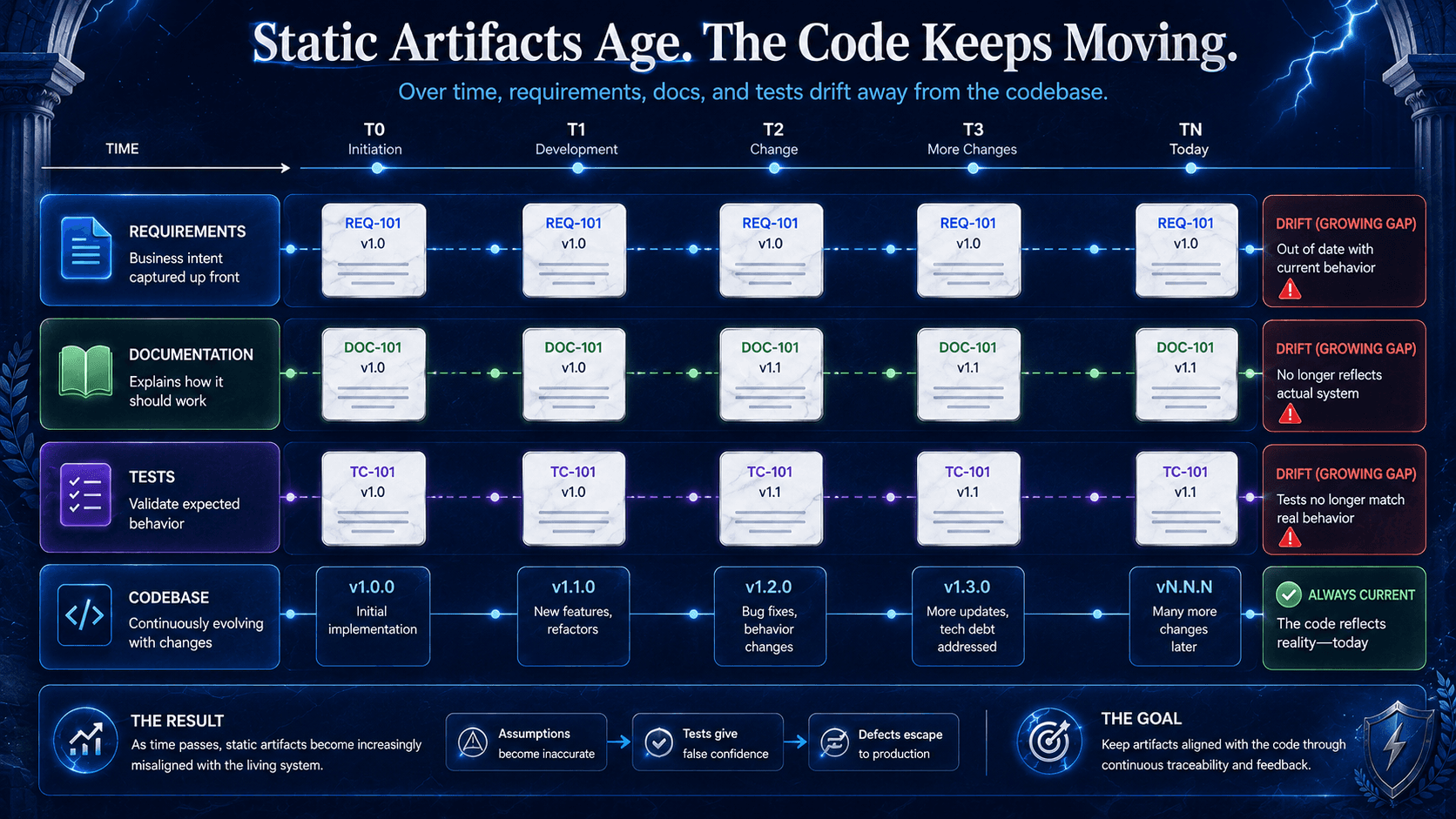
Requirements drift is not a process failure anymore. It is normal operating reality.
In fast-moving teams, product stories, Jira tickets, wiki pages, and test cases age more slowly than the code changes around them. That creates a familiar pattern for QA engineers, SDETs, release managers, and Salesforce QA leads:
The story says one thing, but the branch now does another.
The happy path is documented, but the failure paths are not.
The UI looks fine, but the business rule changed in the controller, validation, or permission layer.
The regression pack proves a page rendered, not that the workflow still works.
This gets sharper in Salesforce environments. A Lightning Web Runtime storefront or Lightning Web Components app can look stable while behavior shifts underneath it through component logic, data handling, routing, permissions, or adjacent platform configuration. Order management and inventory workflows are especially good at hiding that kind of drift until late.
The evidence is not subtle
This is not just a feeling QA teams have.
A 2024 Empirical Software Engineering study found that 28.9% of popular GitHub projects currently had at least one outdated documentation reference, and 82.3% had been outdated at least once in their history. Worse, those mismatches can survive for years because stale documentation fails silently. Source: Springer, “Detecting outdated code element references in software repository documentation”
https://link.springer.com/article/10.1007/s10664-023-10397-6
Research on requirements volatility from Colorado State found that requirement changes closer to release have a greater impact on defect density. Late change does not just make planning messier. It makes testing less effective. Source: “Requirements Volatility and Defect Density”
https://www.cs.colostate.edu/~malaiya/reqvol.pdf
DORA’s documentation research adds the management-level point many teams miss: documentation quality is tied to organizational performance, and it amplifies the payoff of technical practices like continuous integration and delivery. Source: DORA Documentation Quality
https://dora.dev/capabilities/documentation-quality/
Practitioner language sounds even more blunt than the research.
In a 2025 Ministry of Testing discussion on vague requirements, testers warned against relying on intuition because “without requirements you cannot check or validate the product,” while also acknowledging that teams often have to reconstruct truth from conversations and partial context.
https://club.ministryoftesting.com/t/how-do-you-usually-approach-testing-when-the-requirements-are-vague-or-incomplete/84072
In another Ministry of Testing thread, practitioners argued that AI-generated tests get much stronger when the model has access to tests, source code, and requirements together, not just a shallow prompt.
https://club.ministryoftesting.com/t/automatic-test-generation-atg-using-genai/78289
And when developers talk honestly about documentation, they often describe falling back to GitHub search, Slack search, and source comments because the formal docs are already behind. Hacker News captured that sentiment plainly in a 2024 discussion on internal documentation.
https://news.ycombinator.com/item?id=41415619
The stale belief to retire
The outdated belief is this: if requirements exist and coverage is green, QA has enough to trust the release.
It doesn’t.
Coverage is useful, but it is a terrible substitute for confidence. Martin Fowler’s old warning still holds up: coverage tells you something ran, not whether the important behavior was actually validated.
https://martinfowler.com/bliki/TestCoverage.html
That matters because many teams quietly use coverage, automation volume, or smoke-pass rates as a proxy for alignment. But alignment is the harder problem. A 2025 MSR paper on high-level test generation found that practitioners’ primary challenge was not script writing. It was aligning testing with business requirements.
https://2025.msrconf.org/details/msr-2025-technical-papers/2/Automatic-High-Level-Test-Case-Generation-using-Large-Language-Models
So no, the answer is not “more tests.” The answer is fresher test inputs.
What implementation-aware QA looks like
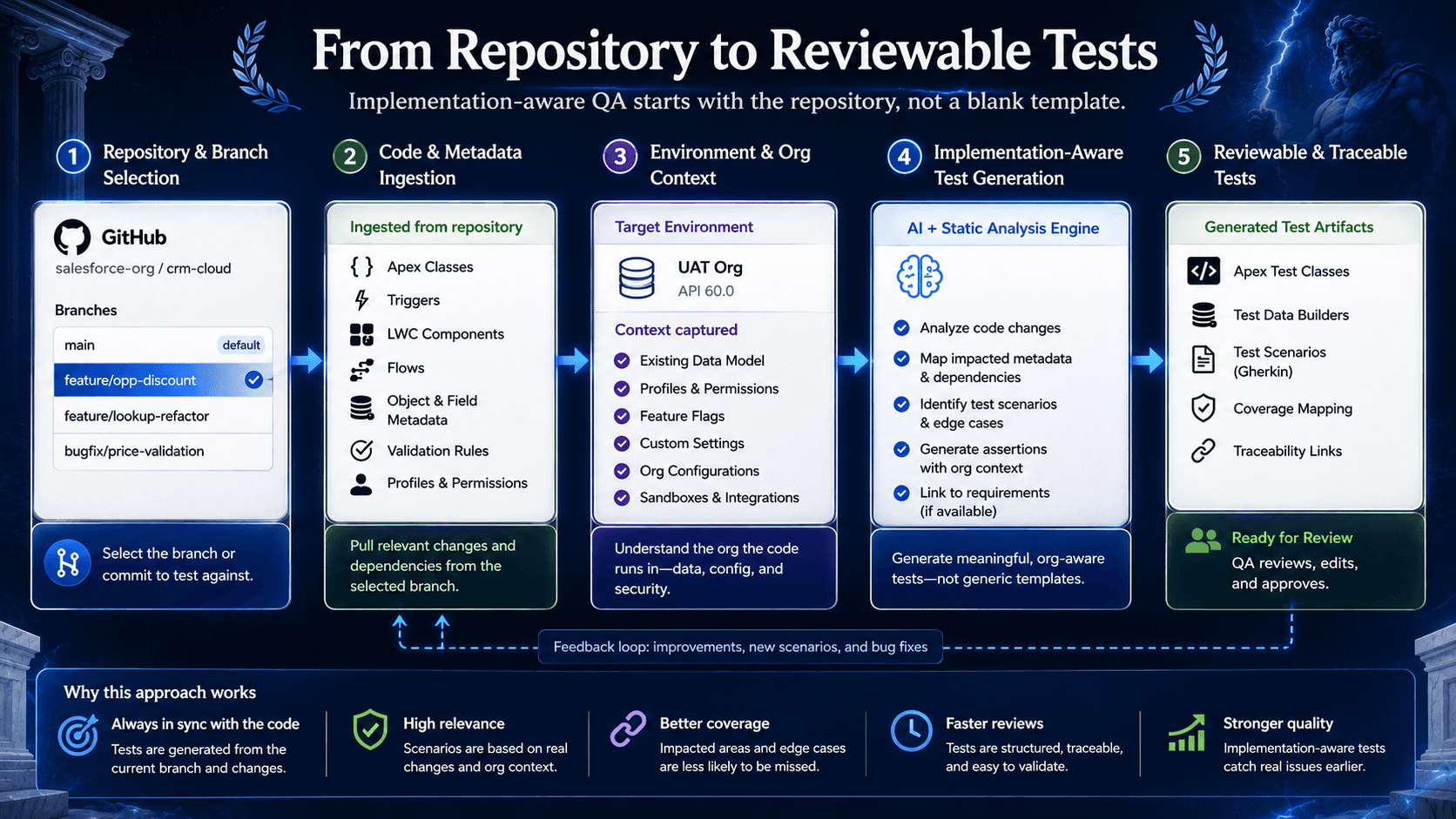
Code-aware test generation is useful because it starts from the implementation surface the team actually shipped.
That means repository context can inform test drafting with signals like:
routes and pages
components and controllers
APIs and validations
permissions and role checks
changed files and branch diffs
business workflow touchpoints
That does not make the codebase the new source of truth for product intent. It makes it the missing source of truth for product reality.
A Salesforce commerce app built with LWR and LWCs makes the problem obvious. If QA is testing order management or inventory flows, a blank test-case template and a maybe-current story are weak starting points. The stronger one is the combination of intended behavior and the implementation currently driving the app. That gives QA a test design grounded in both business intent and live system behavior.
That is the shift behind TestZeus’s codebase-to-test-case workflow. In the demo, the team connects GitHub, selects a repository and branch, attaches that codebase to an environment, and then generates natural-language positive and negative tests for e-bikes order and inventory scenarios. The interesting part is not the demo flow itself. The interesting part is the category shift: QA is no longer drafting only from stale requirements. It is drafting from living implementation context.
A practical framework: SOURCE
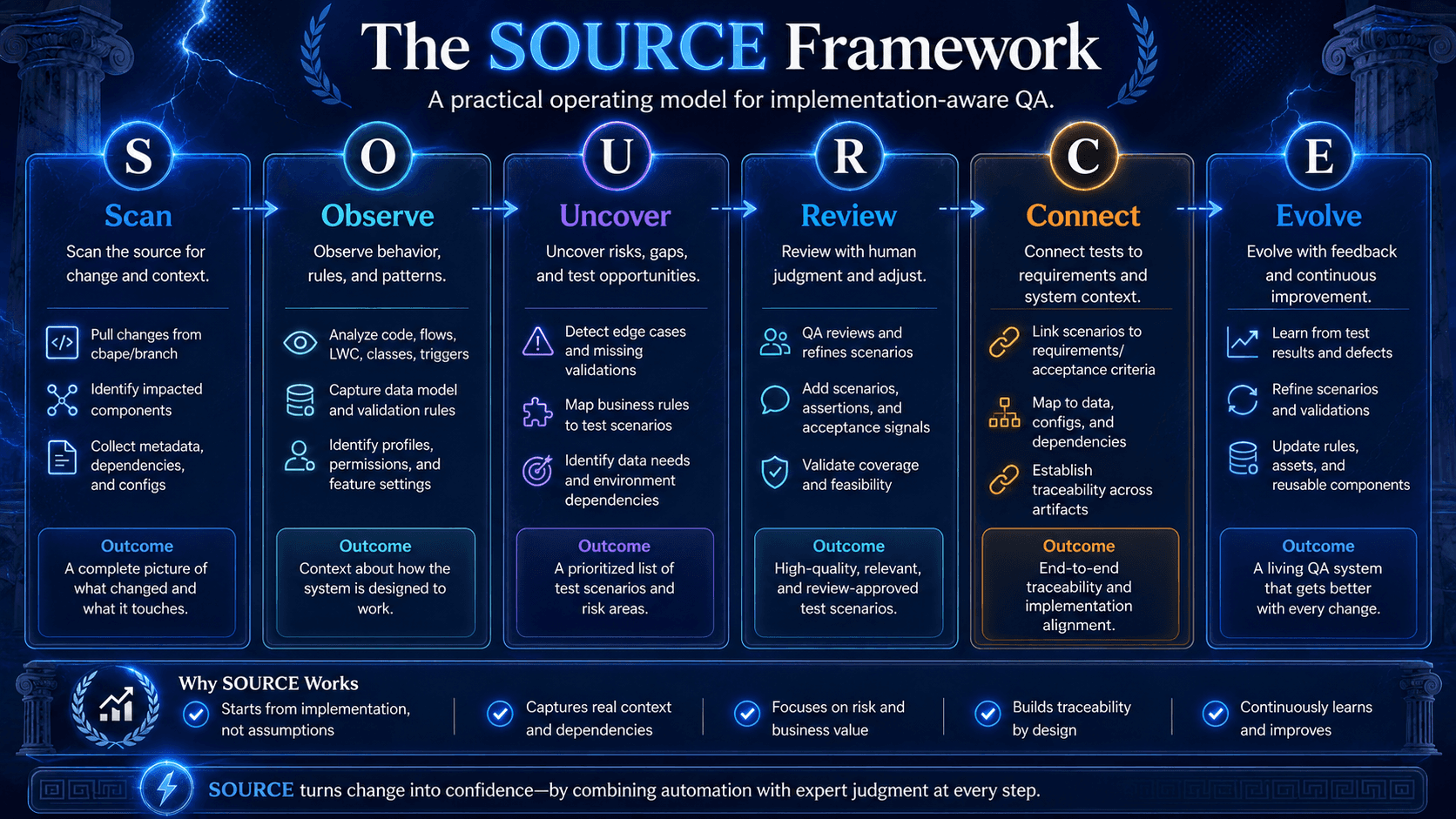
Use this when requirements exist, but you no longer trust them to be complete.
Scan the implementation surface
Look at routes, components, services, validations, permissions, and data dependencies before you draft tests.Observe what changed
Start from the branch or diff. If the code changed, the test strategy should change too.Uncover real workflows
Translate implementation clues into business paths: approval flows, inventory allocation, refund exceptions, role-based restrictions, broken handoffs.Review generated tests against intent
This is where QA judgment matters most. Generated tests are drafts, not truth.Connect to the right environment
Repository, branch, environment, and data assumptions all matter. A clever test drafted from the wrong branch is still wrong.Evolve the regression set continuously
Treat generated tests as living assets. Keep the ones that map to business value. Retire the ones that became noise.
The AI reality check
This is also where a lot of AI-in-testing messaging goes off the rails.
Code-aware generation is helpful. Blind trust is not.
Stack Overflow’s 2025 Developer Survey found that 66% of developers are frustrated by AI outputs that are “almost right,” and only 17% of AI agent users said agents improved collaboration within their team even though productivity gains scored much higher. That is a useful reminder: AI can speed up drafting, but it does not solve judgment, alignment, or release risk by itself.
https://survey.stackoverflow.co/2025/
The smartest position is the least dramatic one. Let AI draft from code. Let humans decide whether the draft proves the behavior that matters.
That is also the TestZeus perspective worth keeping: testing is moving from script maintenance to agent supervision. But supervision is the point. Not surrender.
Practical takeaways
If your team still writes most regression tests from stories alone, you are probably validating yesterday’s product against today’s software.
If your confidence comes mainly from coverage or automation counts, you are measuring activity more than assurance.
If your codebase can tell you which workflows, validations, routes, or permissions changed, it should influence the next test draft.
Requirements are still necessary. They are just no longer sufficient on their own.
Piramal Pharma's engineering team generates tests this way now, pulling context straight from the codebase with TestZeus.
FAQ
What is code-aware test generation?
It is the practice of drafting tests using repository and implementation context so the tests reflect what the software currently does, not just what the documentation once said.
Does code-aware testing replace requirements-based testing?
No. Requirements define intent. Code exposes implemented behavior. Good QA compares both.
Why do requirements and tests drift away from code?
Because code changes continuously while stories, docs, and test cases are updated inconsistently and often too late.
Why is code coverage a weak proxy for confidence?
Because coverage shows execution, not whether the most important business behavior, edge cases, and failure conditions were actually validated.
Why does this matter for Salesforce teams?
Because Salesforce behavior often spans UI components, business logic, permissions, data handling, and platform configuration. A passing UI check can still miss a broken workflow.
Are AI-generated tests reliable enough to run without review?
They are useful as drafts. They are not reliable enough to become the quality gate without human review against intent, risk, and expected outcomes.
A better question for your next release review is not “How many tests do we have?” It is “How many of these tests still reflect the software we are actually shipping?”
// Start testing //