Dreamforce 2026: The Leadership Guide to Trusting Agentforce
What should we actually trust AI agents to do?
Everyone is talking about what AI agents can do next.
At Dreamforce, we think the more interesting question is a little different:
What should we actually trust them to do?
That question came up repeatedly in our recent Humans of Testing | Episode 11, hosted by Robin Gupta, CEO & Co-Founder of TestZeus, with Scott Stafford, Ama Surangika, Chathura Ranasinghe, and Eric Dreshfield from RiseWithVoice.
And it feels like the right question to carry into Dreamforce 2026.
Because Agentforce isn't just about getting AI to answer questions anymore. We're moving toward systems that can reason, work with business data, trigger actions, and operate across workflows.
That changes the question from “Can it do this?” to “Can we trust it to do this?”

Start with trust, not autonomy
One of the simplest comparisons from the panel was also one of the best: treat an AI agent like a new hire.
You don't hand someone unrestricted access on their first day.
You give them context. Start with smaller responsibilities. Review their work. Let them earn more responsibility over time.
Agents deserve the same treatment.
And that trust can't be permanent. The software changes. The data changes. The environment changes. An agent that worked perfectly a few months ago may behave differently when everything around it has changed.
As Scott Stafford pointed out, agents need to be reviewed and recalibrated over time, just as people are.
Trust should be earned continuously, not granted permanently.
Don't just test what the agent says. Test what it does.
This is where things get serious.
An agent can understand the request correctly and still do the wrong thing.
It can give you a perfect answer and then update the wrong record. It can reason correctly and still trigger the wrong workflow. It can have strong guardrails and still take an action that creates a business problem.
That is why the panel kept coming back to one idea: test the action.
Scott Stafford argued for testing the action an agent actually takes, while Ama Surangika emphasized that the action is ultimately what affects the customer and the business.
So instead of asking only:
Did the agent understand the request?
Ask:
Did it take the right action, with the right data, under the right conditions?
That is a much better question for teams putting Agentforce into real workflows.
The data behind the agent matters
We've all heard “garbage in, garbage out.”
With agents, the problem is bigger because the system isn't only generating an answer. It may also be acting on it.
Give an agent poor, outdated, or incomplete data and you can end up with a confident decision built on the wrong context. The panel compared this to training a new employee with bad information: they'll make the wrong decision with confidence.
So before asking what an agent can do, ask:
What exactly are we giving it to work with?
Not everything needs to be autonomous
We're going to hear the word “autonomous” a lot at Dreamforce.
But more autonomy isn't automatically better.
There are tasks where agents should do the heavy lifting. And there are decisions where a human should still make the final call, especially when the consequences involve customers, money, security, healthcare, or other high-impact situations.
The goal isn't to keep humans involved in everything.
It's to be intentional about where human judgment matters most.
The human advantage matters
One of the strongest ideas from the conversation was the shift from “human in the loop” to “human advantage.”
A person doesn't add value just because they're sitting somewhere inside an automated workflow.
People bring things agents don't naturally bring in the same way:
Curiosity. Judgment. Empathy. Relationships. The instinct to stop and question something that doesn't look right.
That's not a weakness in automation.
That's where humans can create more value.
So maybe the better question isn't:
“Where do we put a human in the loop?”
It's:
“Where do we need the human advantage?”
And when agents build agents?
What happens when agents start building, configuring, and testing other agents?
Things will move faster. That's the exciting part.
But someone still has to own the outcome.
As Eric Dreshfield, Scott Stafford, and Ama Surangika discussed, AI can accelerate the work, but people still need to set the direction and take responsibility for what gets built.
More autonomy should mean clearer accountability, not less.
Guide to Dreamforce 2026: Go curious
Dreamforce can get overwhelming quickly. There are keynotes, sessions, demos, booths, community events, and plenty of reasons to change your plan halfway through the day.
The panel had a better approach: don't try to consume everything.
Plan the sessions you genuinely want to attend, but leave room for conversations you didn't schedule.
Eric put it simply: talk to the person next to you, start a conversation, stay open to unexpected connections, and stay curious.
Ama also encouraged attendees to explore sponsor booths and see what problems different solutions are actually solving.
And when you watch an agent demo, don't just ask what it can do. Ask:
What can it access?
What can it change?
What data is shaping its decisions?
Where does a human still need to make the call?
How will you know when it needs to be recalibrated?
Who owns the outcome when it gets something wrong?
These are the questions worth taking beyond the keynote.
Where TestZeus fits into this
At TestZeus, this is the shift we're focused on.
As software becomes more autonomous, testing can't stop at checking whether an application returned the expected response.
We need to understand the agent's behavior, its actions, its data, its failures, and the outcomes it creates.
Our belief is simple: in the age of AI agents, we need agents that can test applications and agents.
Because the more autonomy we give software, the more evidence we need that it deserves that trust.
Heading to Dreamforce?
Swing by TestZeus at Booth #07
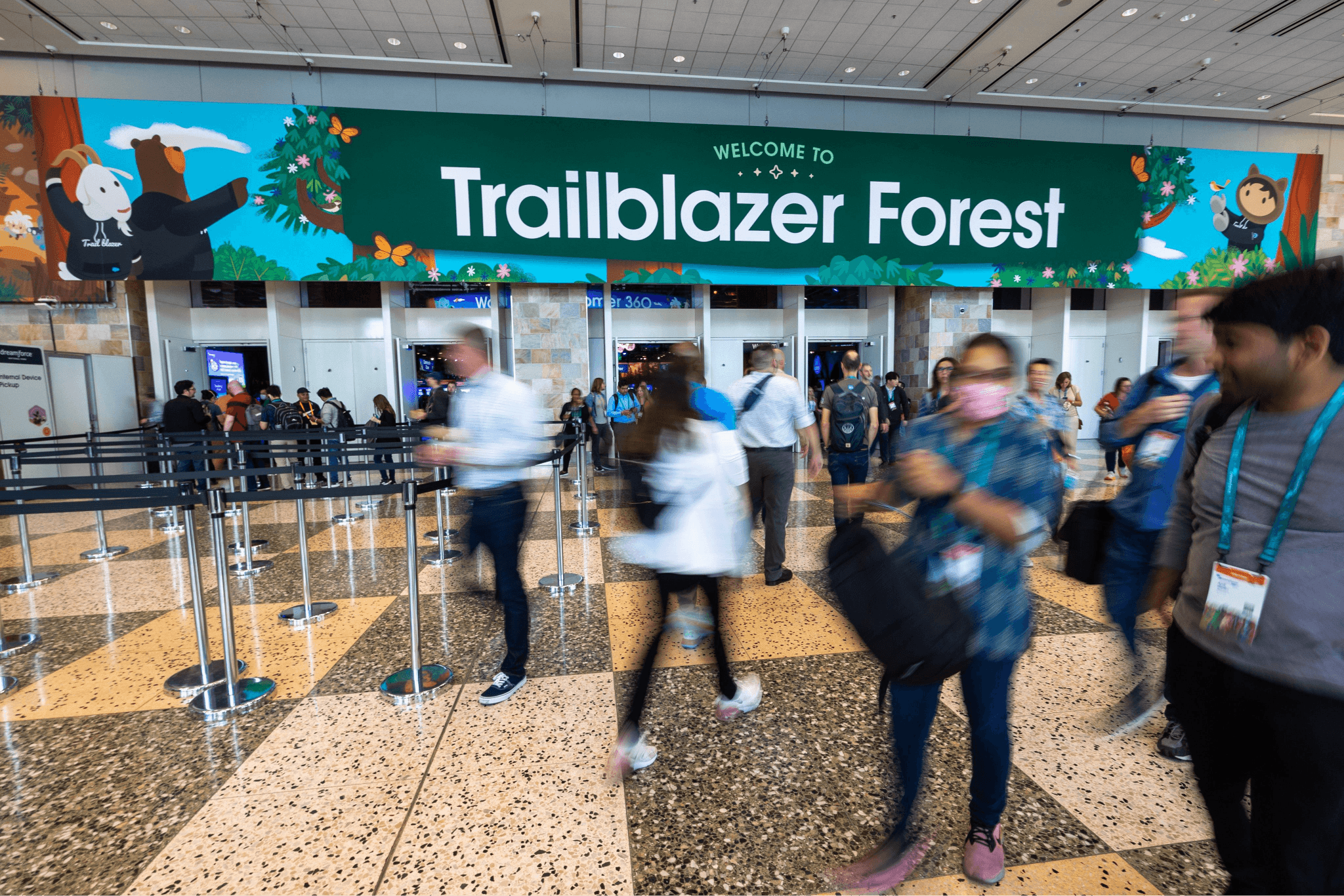
We'll be at Booth #07 in the Trailblazer Forest.
Bring us the Salesforce, Agentforce, automation, or testing problem you're trying to solve.
Tell us what you're not comfortable trusting yet.
Swing by Booth #07, say hello, and let's talk testing.
One last thought
Dreamforce will give us more powerful agents.
But the real challenge isn't making agents as autonomous as possible.
It's building enough trust to let them act, and enough accountability to know when they shouldn't.
That's the conversation we're taking with us to Dreamforce 2026.
And if you're there, come find us at Booth #07.
// Start testing //