The QA Role Is Not Dying. It Is Becoming Agentic.
Is your QA role dying? The answer is no. Learn how to move from test executor to quality system architect by adopting Agentic QA and designing intelligent, supervised workflows.
There is a specific kind of anxiety only QA people understand.
You spend half a day debugging a flaky regression failure. After tracing logs, rerunning tests, and checking environments, you discover nothing is actually broken. The test was. Then you open LinkedIn and see another headline claiming AI will automate testing.
That is where the real anxiety starts.
It is not “Will AI take my job?” in the abstract. It is more practical than that.
It sounds like:
“Are we still going to need someone to write regression scripts?”
“What happens when developers generate tests with Copilot before I even see the build?”
“If an AI agent can click through the browser, inspect the DOM, call APIs, and generate assertions, what exactly is my role?”
Those are not irrational questions. They are the right questions.
But the answer is not that QA disappears.
The answer is that QA moves up the abstraction stack.
For years, quality teams have been buried under execution work: writing scripts, fixing broken selectors, maintaining flaky suites, reproducing bugs, validating releases, documenting evidence, and chasing environment issues that nobody wants to own.
Agentic QA changes the job description.
Not from “tester” to “prompt writer.”
From test executor to quality system architect.
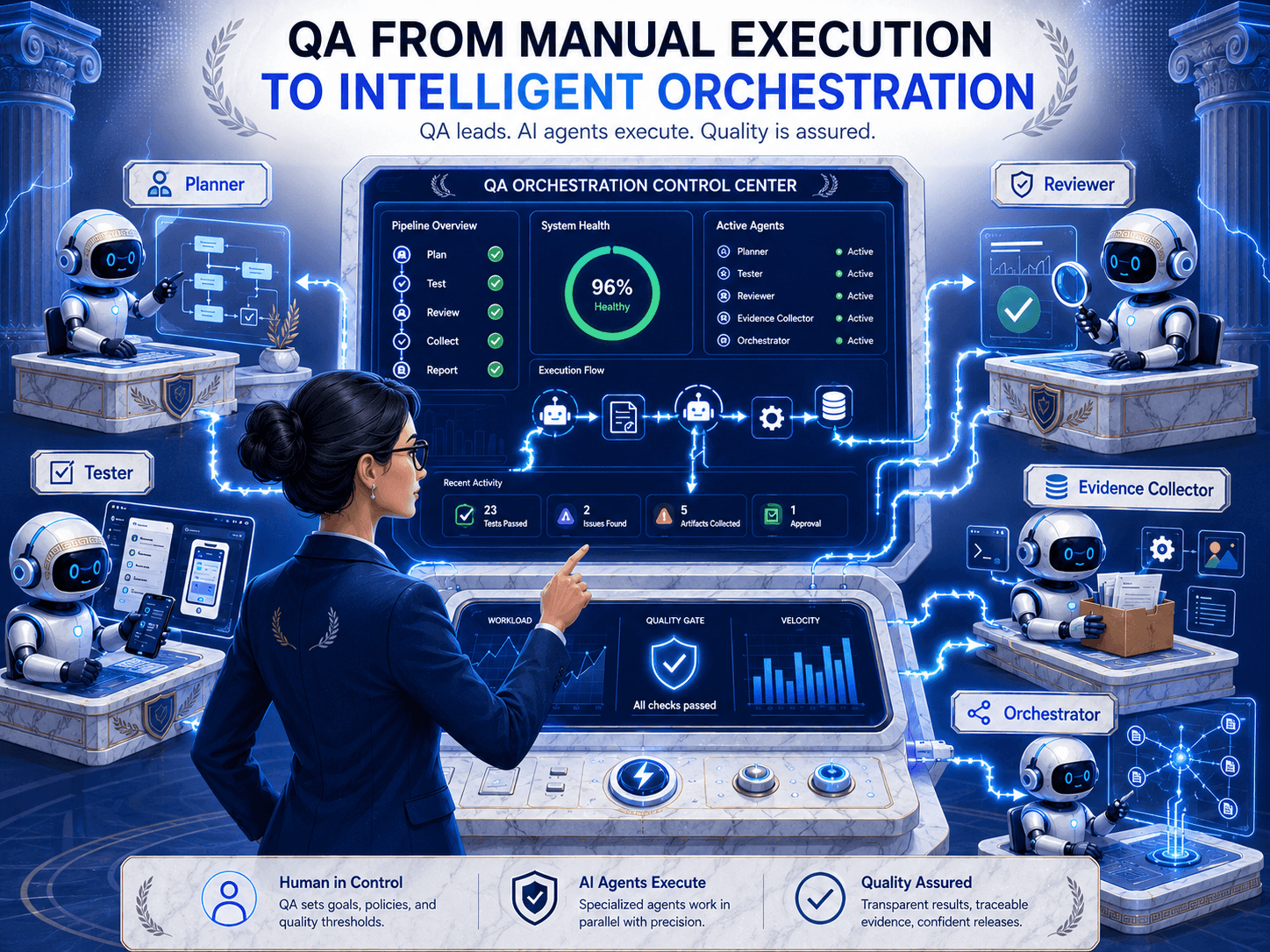
The next-generation QA professional will not be judged by how many scripts they personally maintain. They will be judged by how well they can define intent, supervise agents, review evidence, design workflows, manage risk, and govern releases at machine speed.
That is the real shift.
Not QA versus AI.
QA with a team of agents.
Prompting Is Not Testing
Let’s get one thing out of the way.
A QA engineer who types “write me test cases for this login page” into a chatbot has not become an Agentic QA.
They have used a chatbot.
That can be useful. It can speed up ideation. It can help draft edge cases. It can summarize requirements. It can even generate starter automation code.
But it is not the same as testing.
Testing requires judgment.
Testing asks:
What matters if this fails?
Which user journey carries the most business risk?
What evidence proves this release is safe enough?
Which failures are real defects and which are environment noise?
Where is automation creating false confidence?
What should block a release?
What should merely be watched?
A chatbot can help you think.
An agent can help you act.
But QA still owns the truth.
That distinction matters because the industry is entering a strange middle phase. AI can produce more code, more test cases, more logs, more screenshots, more reports, and more green dashboards than ever before. The bottleneck is no longer generation.
The bottleneck is trust.
The Stack Overflow 2024 Developer Survey showed that developers using AI tools mostly used them for writing code, while those interested in AI were especially curious about testing code. But the same survey also showed skepticism around complex tasks, with many respondents rating AI tools as weak or inconsistent when complexity increased.
That is exactly where QA becomes more important, not less.
When systems generate more output, someone has to decide what output deserves confidence.
AI in Testing: The Old QA Stack Is Under Pressure
The conversation around AI in testing often focuses on speed. The more important question is how quality ownership changes when execution becomes increasingly automated.
The traditional QA career ladder was built around execution depth.
Manual tester.
Automation tester.
SDET.
QA lead.
Quality architect.
That ladder still matters. But the work inside each level is changing.
Manual validation is being compressed by AI-assisted exploration. Script writing is being accelerated by code generation. Test data creation is increasingly assisted by generative models. Browser automation is moving from hand-coded selectors toward agents that can perceive and interact with pages more flexibly.
PractiTest’s 2025 State of Testing report shows that AI adoption in testing is growing but still cautious. According to the report, 45.65% of respondents had not yet integrated AI tools into testing processes, while common AI use cases included test case creation and test data generation. The gap is not interest. The gap is confidence, readiness, and operational trust.
The World Quality Report 2025 points in the same direction. Interest in generative AI across quality engineering is rising fast, but enterprise-scale adoption is still slowed by integration complexity, data privacy concerns, and skill gaps.
That tells us something important.
AI in QA is not blocked because teams cannot imagine use cases.
It is blocked because quality work is not just output generation. It is system design, context, compliance, evidence, and judgment.
This is why the QA role is not dying.
The repetitive layer is being automated.
The judgment layer is becoming more valuable.
What “Agentic QA” Actually Means
In TestZeus University’s “Becoming an Agentic QA,” Robin, co-founder and CEO of TestZeus, frames the shift clearly: QA professionals are not simply learning another tool. They are learning how to orchestrate intelligence.
That starts with understanding the difference between LLMs, agents, and multi-agent systems.
A large language model can generate, predict, explain, summarize, and draft. But on its own, it is limited.
It is static because it only knows what it has access to.
It is reactive because it waits for a prompt.
It is isolated because it cannot independently click through an application, query a database, trigger an API, inspect a build, or verify a workflow unless connected to tools.
An AI agent is different.
An agent has a goal, tools, memory, autonomy, and the ability to operate in a loop.
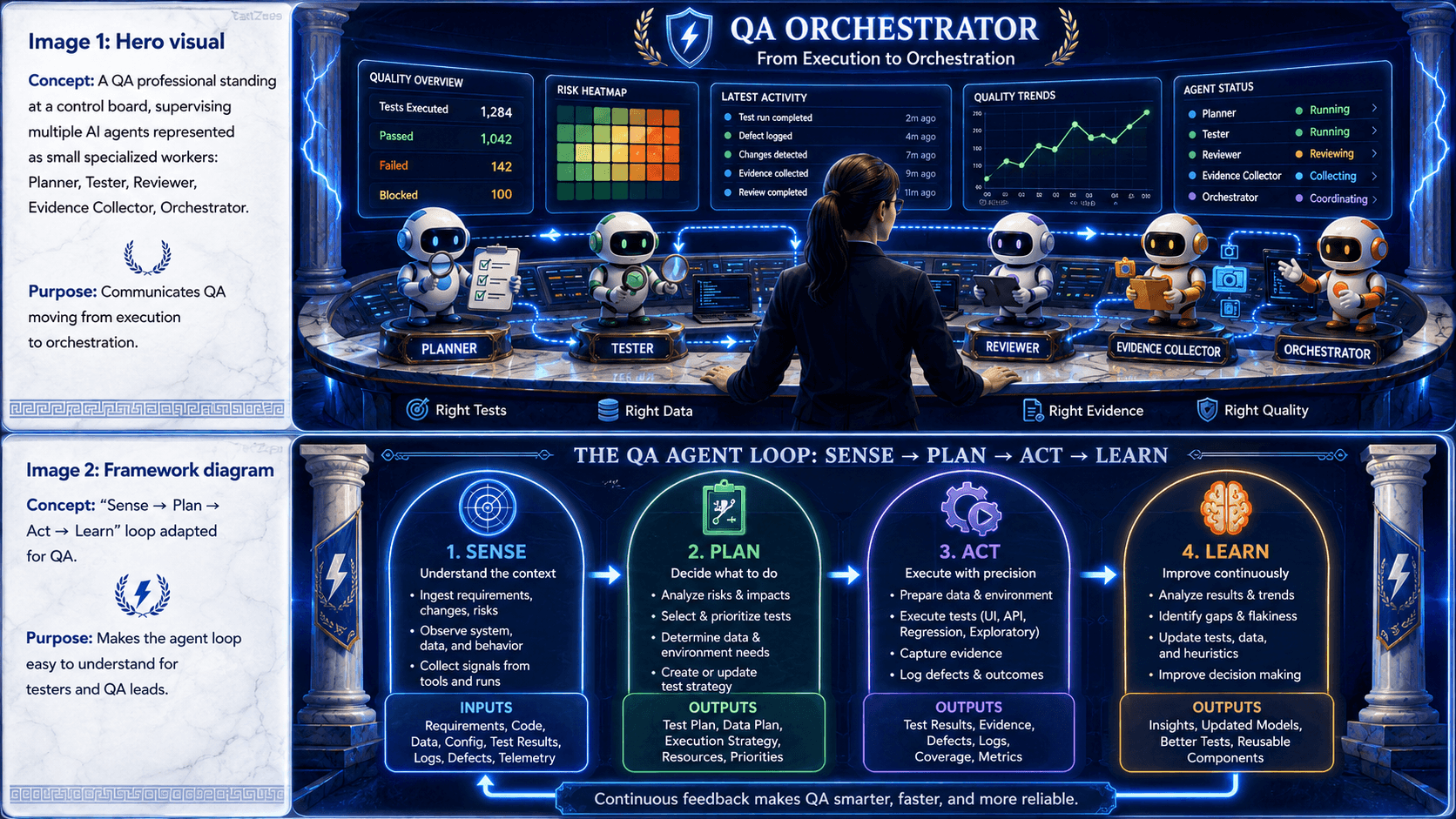
The course describes this as a Sense -> Plan -> Act -> Learn cycle.
That loop is the beginning of Agentic QA.
But the more interesting part is not one agent.
It is many.
Complex QA work rarely fits inside one giant prompt. A single “God Model” trying to plan, code, test, debug, review, report, and govern everything quickly becomes brittle. It can loop, lose context, overreach, hallucinate, or become impossible to debug.
That is why serious agentic systems increasingly resemble software architecture.
Specialized agents.
Clear responsibilities.
Shared context.
Orchestration.
Review gates.
Anthropic’s guidance on building effective agents makes a similar point: start with simple workflows where possible and only add agentic complexity when the task genuinely requires it. Microsoft’s Azure Architecture Center also describes orchestration patterns such as sequential, concurrent, group chat, and handoff workflows for tasks that exceed what a single agent with tools can reliably handle.
That is the category shift.
Agentic QA is not “AI writes tests.”
Agentic QA is quality work decomposed into intelligent, supervised workflows.
The QA Engineer Becomes the Orchestrator
A modern QA workflow may soon look less like this:
QA engineer writes test cases -> writes scripts -> runs suite -> triages failures -> files bugs.
And more like this:
QA engineer defines the release risk model -> agents explore flows -> specialized agents generate and run tests -> reviewer agents inspect evidence -> QA approves, rejects, or escalates outcomes.
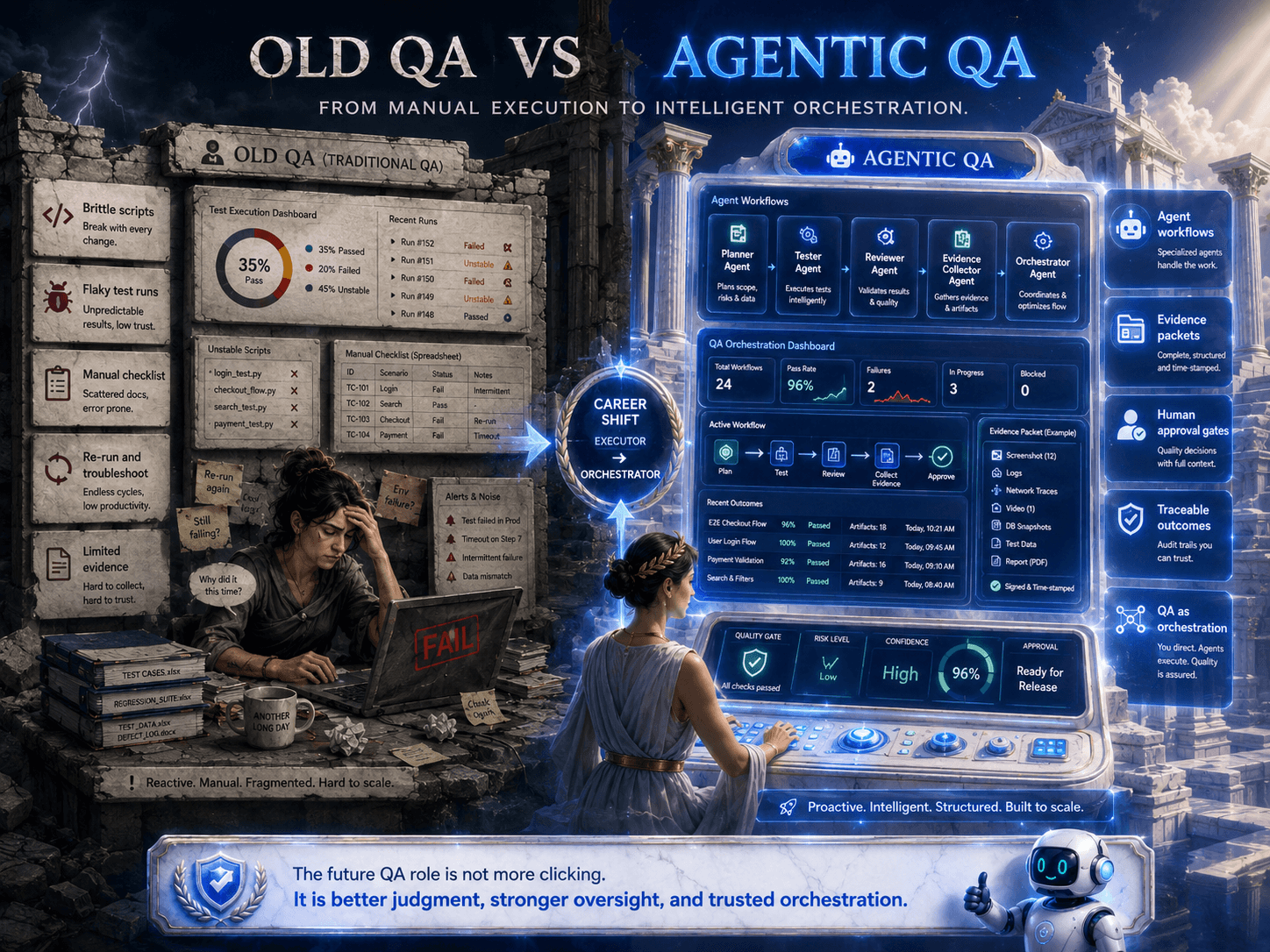
In that model, the QA professional is not removed.
They become the person who designs the operating system for quality.
Think of the agentic QA team as a set of specialized workers.
The human QA professional defines the boundaries.
What is allowed?
What is risky?
What needs human approval?
What counts as evidence?
What is a release blocker?
What can be retried automatically?
What must never be changed by an agent?
That is not a smaller role.
That is a higher-leverage role.
The Uncomfortable Truth: More Automation Can Create More Noise
QA teams already know this.
A bigger test suite does not automatically mean better quality.
Sometimes it means more maintenance, more false failures, more ignored alerts, more reruns, and more meetings where everyone debates whether the pipeline is just flaky again.
Google’s research on flaky tests describes the problem clearly: regression tests are expected to be deterministic, but flaky tests produce unreliable results and disrupt software development workflows.
Now add AI agents to that environment.
If the underlying quality system is messy, agents will not magically fix it. They may amplify it.
They may generate too many tests.
They may overfit to happy paths.
They may miss product nuance.
They may produce assertions that look valid but check the wrong thing.
They may retry failures until a real defect disappears into noise.
They may produce beautiful reports that nobody should trust.
That is why Agentic QA cannot be treated as “let AI do testing.”
It has to be treated as a governance discipline.
The point is not to let agents run wild.
The point is to build a system where agents can operate safely, produce reviewable evidence, and escalate uncertainty.
OpenAI’s Agents SDK documentation explicitly includes guardrails and human review patterns for safer, more controlled agent workflows. NIST’s AI Risk Management Framework lands in a familiar place too: structure, measurement, oversight, accountability.
QA people should feel very familiar with that.
This is what good testers have always done.
They ask: where can this fail, how would we know, and who is accountable?
A Practical Framework for Becoming an Agentic QA
You do not become agentic by memorizing AI vocabulary.
You become agentic by changing how you design quality work.
1. Move from test cases to test missions
A test case tells someone what to do.
A test mission tells an agent what outcome to achieve and what constraints to respect.
Weak prompt:
Test the checkout page.
Better mission:
Validate that a logged-in user can complete checkout with a saved card, that the order total remains consistent across cart, payment, and confirmation pages, and that the order record is created correctly in the backend. Capture screenshots, network evidence, and any mismatch between UI and API state. Do not modify production data.
That is a very different skill.
Agentic QA requires precise intent.
Not vague prompting.
2. Define evidence before execution
Before an agent runs, decide what proof matters.
For a payment workflow, evidence may include:
Screenshots of each critical state
API response payloads
Database order record
Payment status
Error logs
Trace IDs
Assertion summary
Reproducibility notes
Without evidence standards, agents create noise.
With evidence standards, agents create reviewable quality signals.
3. Split work into specialized agents
Do not ask one agent to do everything.
A better pattern is:
One agent reads requirements.
One agent maps workflows.
One agent generates tests.
One agent executes tests.
One agent reviews evidence.
One human approves release impact.
This mirrors the microservices idea from TestZeus University’s transcript: avoid the monolith, design specialized workers, and coordinate them through orchestration.
4. Keep humans in the loop where risk is high
Not every action needs human approval.
But some actions absolutely do.
Examples:
Deleting or modifying data
Running tests in production-like environments
Creating release-blocking defects
Updating test baselines
Marking failures as non-issues
Approving regulated workflows
Changing CI/CD gates
Agentic QA is not about trusting agents blindly.
It is about knowing where trust is earned, where it is provisional, and where it is not allowed.
5. Review uncertainty, not just failure
Traditional automation reports pass or fail.
Agentic systems should also report uncertainty.
A good agent should be able to say:
“I completed the workflow, but the API response did not include a field needed for full verification.”
“The UI changed after reload, but I cannot determine whether this is expected.”
“The test passed after retry, but the first failure suggests possible flakiness.”
“The selector was ambiguous, so this result needs human review.”
This is where QA judgment becomes central.
The future is not just green or red.
It is confidence scoring, evidence review, and risk-based release decisions.
The New QA Skill Stack
The Agentic QA skill stack is not “learn machine learning.”
Most QA professionals do not need to become ML engineers.
They need to become better at orchestrating AI-assisted quality systems.
That means building strength in six areas.
1. Product judgment
You need to know which flows matter.
Agents can explore. They can execute. But they do not automatically understand business priority.
A checkout failure is not the same as a tooltip failure.
A broken permission model is not the same as a visual alignment issue.
Agentic QA starts with knowing what risk means.
2. Systems thinking
You need to understand how the product behaves across UI, API, database, integrations, queues, third-party systems, and deployment environments.
Agents work best when you can give them the right tools and boundaries.
3. Workflow design
The future QA professional designs agent workflows the way automation engineers once designed test suites.
What runs first?
What runs in parallel?
What needs review?
What is retried?
What is quarantined?
What gets escalated?
4. Evidence literacy
You need to evaluate screenshots, traces, logs, assertions, diffs, and reports.
The question is not “Did the agent say it passed?”
The question is “Does the evidence support the claim?”
5. Governance
You need to define safe operating rules.
Agents need permissions, limits, audit trails, review points, and rollback plans.
This becomes especially important in enterprise QA, Salesforce testing, financial workflows, healthcare platforms, and any environment where bad automation can create real damage.
6. Communication
Agentic QA will produce more machine-generated information.
Someone still needs to translate that into release decisions.
A QA lead who can say, “Here is what we tested, here is what the agents found, here is the evidence, here is the residual risk, and here is my recommendation,” will become more valuable.
Not less.
The Contrarian POV: AI Will Punish Shallow QA and Reward Serious QA
AI will not treat every QA role equally.
That is the uncomfortable part.
If someone’s entire value is copying acceptance criteria into test cases, executing rote checks, and maintaining brittle scripts without understanding risk, then yes, that work is exposed.
But if a QA professional understands product behavior, edge cases, systems, user risk, release confidence, and evidence, AI gives them leverage.
AI punishes shallow execution.
It rewards deep judgment.
That is why “QA is dying” is the wrong framing.
A certain version of QA is dying.
The version where testers are treated as downstream script maintainers.
The version where quality is reduced to “how many automated tests do we have?”
The version where QA is pulled in late, asked to click around, and blamed when production breaks.
Good riddance.
Agentic QA creates space for a better version of the role.
One where QA defines the quality architecture before the release is already on fire.
What This Means for QA Leads
For QA leaders, the question is not whether AI belongs in testing.
It is how to introduce it without creating chaos.
Start with workflows where agentic systems can help but not cause major damage.
Good starting points:
Requirement analysis
Test idea generation
Regression impact mapping
Exploratory session planning
Test data generation in safe environments
UI smoke test execution
Evidence collection
Flaky test triage
Release note validation
Bug report enrichment
Avoid starting with fully autonomous release approval.
That is the last mile, not the first experiment.
What This Means for Individual QA Engineers
The best thing a QA engineer can do right now is not panic.
The second-best thing is to stop defining themselves by script output.
Start practicing the work that agents cannot own independently:
Turn vague requirements into testable missions.
Write better acceptance and rejection criteria.
Learn how APIs, databases, logs, and CI pipelines connect.
Build comfort reviewing machine-generated tests.
Practice identifying weak assertions.
Ask what evidence would prove a workflow is truly correct.
Learn how agent loops work.
Learn how orchestration patterns work.
Get better at explaining risk to engineering and product leaders.
The person who understands both testing and agent supervision becomes extremely useful.
Because every organization adopting AI will eventually ask:
“Can we trust this?”
That is a QA question.
Where TestZeus Fits into This Shift
TestZeus’s view is that QA professionals are moving from script execution to agent orchestration.
That is the deeper meaning behind “Becoming an Agentic QA.”
It is not a course announcement.
It is a category signal.
The testing world is moving toward systems where agents can plan, execute, inspect, and adapt across complex application workflows. But those systems still need humans who understand quality, risk, evidence, and governance.
The Agentic QA is that human.
The architect.
The reviewer.
The release confidence owner.
The person who knows that a generated test is not automatically a good test, a passing run is not automatically proof, and an autonomous workflow is not automatically safe.
For teams exploring this shift, TestZeus is building toward that future: AI-assisted, agentic software testing where QA professionals can supervise intelligent systems instead of drowning in repetitive execution.
Ready to become an Agentic QA? Start designing intelligent workflows now, Explore TestZeus today: https://testzeus.com/
Raiffeisen Bank International's QA team made this same move from test executor to quality system architect with TestZeus.
FAQs
Is Agentic QA the same as test automation?
No. Traditional test automation usually executes predefined scripts. Agentic QA uses AI agents that can interpret goals, plan steps, use tools, inspect results, adapt to failures, and escalate uncertainty. Automation is part of Agentic QA, but Agentic QA is broader.
Will AI agents replace QA engineers?
AI agents will automate parts of QA execution, especially repetitive scripting, test generation, and evidence collection. But QA engineers remain essential for defining risk, reviewing evidence, designing workflows, setting guardrails, and making release decisions.
Do QA engineers need to become machine learning engineers?
No. Most QA professionals do not need to build foundation models. They need to understand how agents work, how to design testing workflows, how to evaluate AI-generated output, and how to govern quality systems safely.
What skills matter most for Agentic QA?
The most important skills are product judgment, systems thinking, workflow design, evidence review, risk analysis, API and data literacy, automation fundamentals, and clear communication with engineering and product teams.
Why are multi-agent systems useful in QA?
Complex testing often requires different kinds of work: planning, exploration, automation, data setup, execution, review, and reporting. Multi-agent systems allow specialized agents to handle different parts of the workflow instead of relying on one monolithic prompt or model.
What should QA teams automate first with agents?
Start with bounded, reviewable workflows such as test idea generation, requirement analysis, exploratory planning, smoke testing, evidence collection, flaky test triage, and bug report enrichment. Avoid fully autonomous release approval until governance is mature.
// Start testing //