Playwright Is Free. The Testing System Isn’t.
Why in-house AI-powered test automation can become death by a thousand cuts.
Playwright is free. Coding agents can generate scripts quickly. Neither fact tells an enterprise what a reliable testing capability will cost.
The mistake is comparing the cost of a Playwright licence with the price of a commercial testing product. The real comparison is lifetime ownership of a testing system versus purchasing a managed outcome. That means accounting for framework engineering, AI exploration, test validation, cloud execution, failure triage, maintenance, governance, and opportunity cost.
The first script is the easy part
Coding agents can inspect a page, generate Playwright, execute tests, read failures, and patch code. That makes implementation faster. It does not remove the rest of the job.
Teams still have to decide what to test, what should happen, which data and identity are valid, how to run tests at scale, why a test failed, and whether a repair preserved business meaning.
That is why a successful demo can create false confidence. A demo may use one environment, one user, a friendly flow, and a visible green result. A production capability has to remain trustworthy across releases, users, roles, data states, browsers, geographies, integrations, and team turnover.
A green test is not necessarily a correct test. An agent can weaken assertions, delete scope, optimize to the checker, or act on the wrong enterprise record and still return a pass.

The hidden bill is everywhere
No single cost looks fatal.
There is the extra model call when a DOM snapshot is incomplete. The retry when a background Salesforce job has not finished. The cloud worker waiting in a queue. The failed login after a role, token, or MFA policy changes. The screenshots, videos, and traces retained for failed runs. The human deciding whether the application or the test is wrong. Then there is the repair that needs revalidation.
The visible test code sits on top of a much larger system.
That system includes browser automation, identity and security, test data, cloud execution, evidence, failure operations, an AI control plane, and governance. It also needs locators, assertions, authentication, permissions, secrets, synthetic records, retries, screenshots, videos, traces, audit logs, tool schemas, model routing, budgets, stopping rules, and approval workflows.
The AI layer does not replace these components. It sits on top of them. The agent still needs a safe environment, controlled actions, useful context, deterministic tools, budgets, stopping conditions, and a way to escalate uncertainty.

Where AI sits changes the economics
The whitepaper describes three operating models.
In an AI-authored, deterministic model, AI helps create and repair tests, but accepted TypeScript runs without an LLM on every step. In a hybrid escalation model, the deterministic path runs first and AI is used for exploration, failed resolution, or diagnosis. In fully agentic execution, the LLM observes and reasons during every run, which introduces recurring token, latency, and variance costs.
For stable regression, the recommended architecture is to compile AI-assisted discovery into deterministic Playwright where possible, while reserving agentic reasoning for unknown workflows, high-volatility paths, and failures that deterministic recovery cannot resolve.
That distinction matters because AI usage can accumulate throughout the lifecycle. Recent research reviewed in the paper found that repeated runs of the same task could vary by up to 30x in token usage, while different harnesses running the same model produced up to a 40x difference in tokens per solved task with pass-rate differences of only 0–8 percentage points. The paper therefore treats the model-harness pair, rather than the model name alone, as the relevant economic unit.
Salesforce makes the problem harder
Enterprise UI testing is not simply a larger version of testing a public e-commerce demo.
Salesforce-like environments combine dynamic interfaces with business configuration, identity, data, and integration state. The same textual step can render differently across orgs, profiles, and releases.
The deeper problem is knowing what should happen.
A test agent may see that a record was saved. It may not know whether it used the correct account, respected the user’s permission, triggered the expected flow, produced the correct downstream event, or violated a rule that exists only in business documentation.
This is also why precise labels and well-specified test cases can create false confidence. In the internal experiment, high-quality application labels and supplied Gherkin values reduced the discovery burden. When those conditions are missing, exploration expands through more browser steps, DOM snapshots, screenshots, context, retries, and human questions.
Build, buy, or operate?
An internal framework can still be the right choice.
It makes more economic sense when an organization already has engineers who understand the application, production-ready CI, secrets, environments, test data, browser execution, and enough test volume to justify the fixed platform investment. It also requires acceptance of failure triage and repair as an ongoing engineering function.
A managed product or service deserves serious consideration when automation infrastructure is immature, high-value workflows need coverage quickly, or leadership wants evidence, diagnosis, maintenance, and governance as an outcome rather than another platform to operate.
The important point is that none of the sourcing models makes the underlying work disappear. They package people, AI expertise, infrastructure, coverage, execution, diagnosis, reporting, and maintenance differently.
Measure the system, not the demo
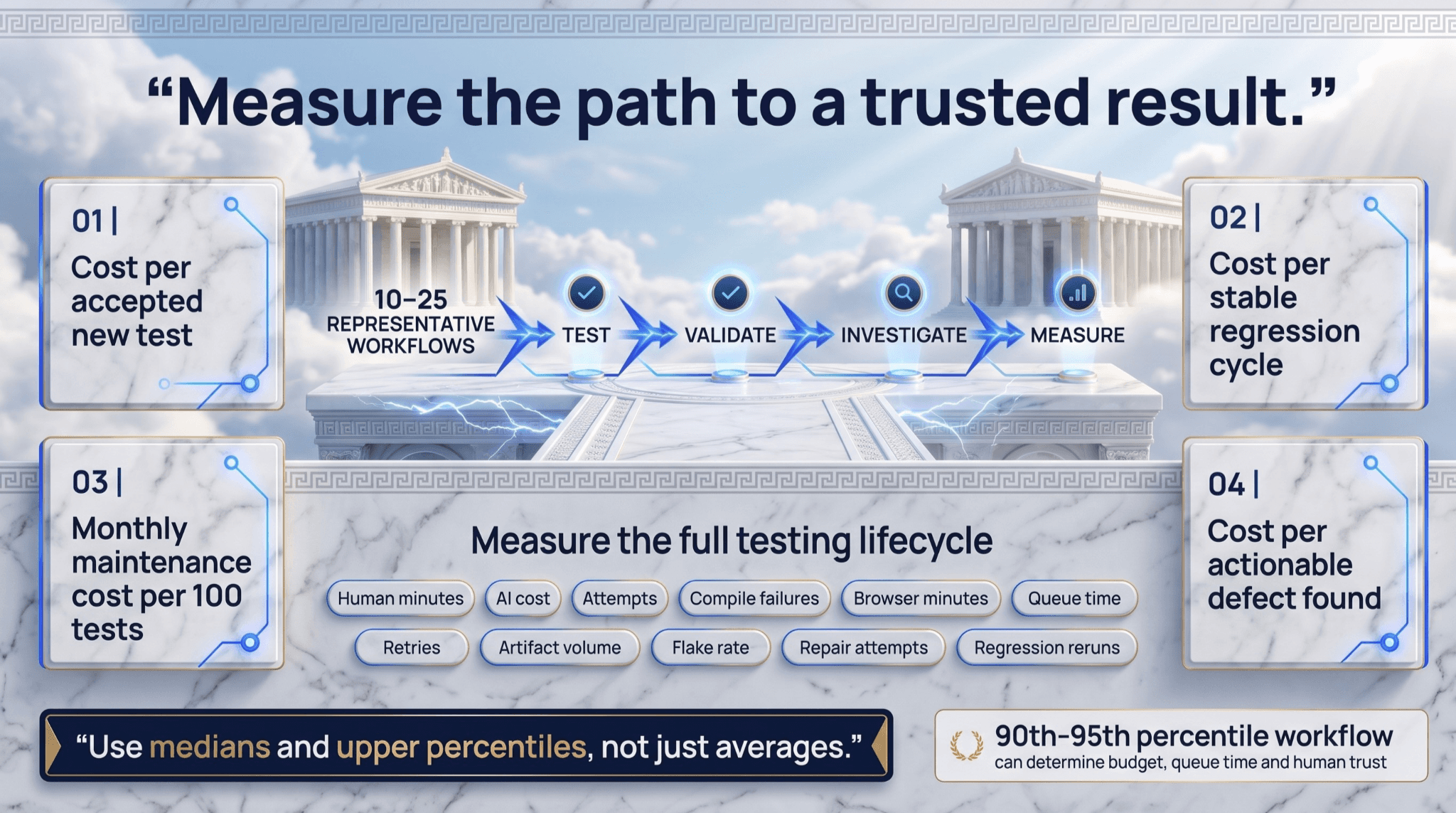
A credible proof of concept should measure the entire path to a trusted result, not just whether tests were generated or finished.
The whitepaper recommends using 10–25 representative workflows across simple, dynamic, role-sensitive, data-heavy, and integration-dependent scenarios. The key measures include cost per accepted new test, cost per stable regression cycle, monthly maintenance cost per 100 tests, and cost per actionable defect found.
Use medians and upper percentiles rather than averages alone. The paper notes that agent cost is heavy-tailed, and that the 90th- or 95th-percentile workflow may determine budget, queue time, and human trust. A trial that cannot show token logs, human minutes, artifact quality, and failure attribution is not giving enough evidence.
The central economic lesson is simple: the cost of a new test is not the generation call. It is the entire path from business intent to an accepted, repeatable artifact.
Code is cheaper. Accountability is not.
AI has changed test automation. A strong engineer can generate a clean Playwright test faster, explore unfamiliar pages, summarize traces, and draft repairs. The opportunity is real.
The dangerous leap is assuming that faster code means cheap testing.
Enterprise test automation remains a system of truth, state, execution, and accountability. Its cost is spread across context, retries, roles, records, environments, workers, tunnels, artifacts, triage, repair review, governance, and people. Each obligation looks manageable on its own. Together, they become a permanent operating model.
Know your number before you commit to a build.
TestZeus offers a build-vs-buy scorecard, cost-per-accepted-test benchmark, architecture review, and proof-of-concept design around representative workflows to pressure-test the decision against an organization’s own testing economics.
// Start testing //